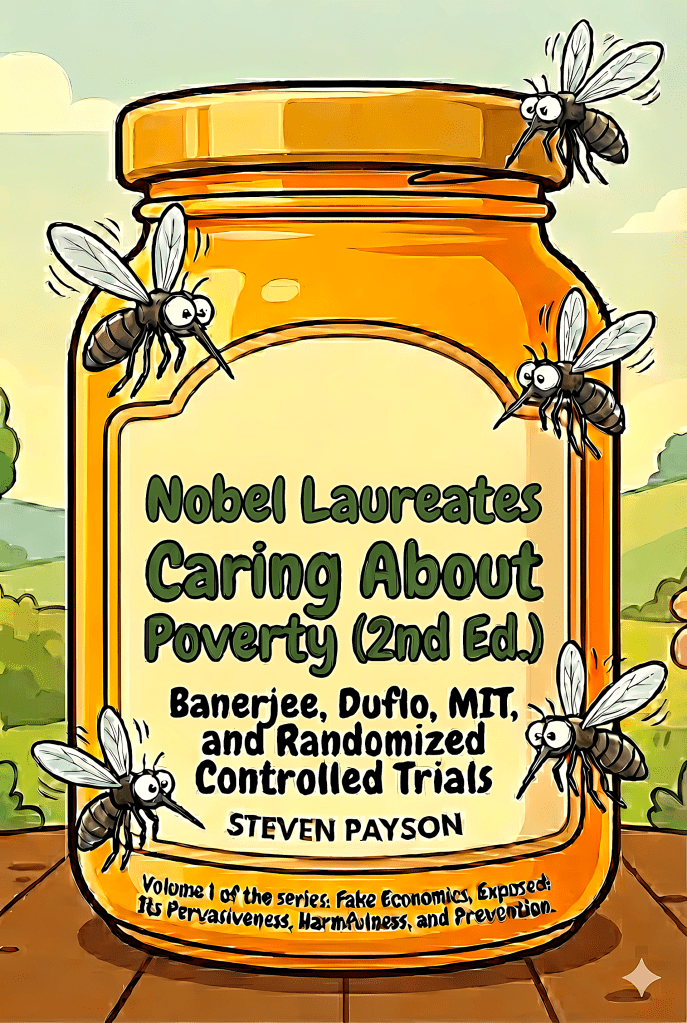
For the better part of two decades, development economics has been held captive by a ‘clinical’ revolution. What began as a niche statistical tool has, through a masterclass in institutional branding, been elevated to the undisputed ‘Gold Standard’ of economic science. We are told a heartwarming tale of ‘Nobel laureates caring about poverty’, a narrative where the ‘bottom billion’ are finally being saved by the rigorous, scientific tinkering of MIT and Harvard.
But as I argue in the newly released second edition of Nobel Laureates Caring About Poverty: Banerjee, Duflo, MIT, and Randomized Controlled Trials(2026), if we strip away the public relations sheen, a far more cynical reality emerges. This is not a story of scientific discovery but an ‘Inside Job’ executed with clinical precision. It is a rebranding exercise designed to cement institutional power and create a circular monopoly over global funding and academic prestige.
The Fable of the Mosquitoes: A Modern Inversion. For those of us steeped in the history of economic thought, this movement is best understood through what I have termed the ‘Fable of the Mosquitoes’. This is a sharp, subversive nod to Bernard Mandeville’s The Fable of the Bees: or, Private Vices, Publick Benefits (1714). Mandeville’s scandalous thesis was that ‘private vices’, the selfish desires, vanities, and greed of individuals, paradoxically resulted in ‘public benefits’ by driving industry, luxury, and national wealth.
In the hallowed halls of the Academic Apex, specifically within the MIT-based J-PAL ecosystem, we are witnessing a modern, distorted inversion of this paradox. The private vices of our profession such as institutional cronyism, the relentless pursuit of prestige, and a clinical detachment from macro-economic reality are being marketed to the global public as a supreme public benefit: the ‘scientific’ eradication of poverty. However, where Mandeville’s bees were industrious workers, whose self-interest accidentally created honey, the researchers and power brokers of the Randomista network are the mosquitoes of the story. They thrive by drawing blood in the form of massive donor grants, taxpayer-funded overheads, and academic accolades from the very populations they claim to serve, all the while weaving a ‘Mosquito Fable’ that masks the fundamental failure of their methodology. According to this fable it was RCTs that we should thank for poor African villages receiving mosquito nets to protect them from the mosquitoes that spread malaria.
The Semiotic Heist: Clinical Cosplay in the Village. The meteoric ascent of RCTs relies on what I call ‘Clinical Cosplay’, the strategic adoption of medical terminology and protocols to grant economic research an unearned aura of scientific finality. By borrowing the language of ‘treatments’, ‘placebos’, and ‘clinical trials’, the Randomistas have executed a semiotic heist. They have convinced donors that they are ‘playing doctor’ to a sick planet, when in reality, we are often merely witnessing the verification of the obvious at taxpayer expense.
Take, for example, the ‘Eyeglasses Scandal’. The Academic Apex has extracted incredible research mileage from a single, pedantic question: do eyeglasses help people see? We do not need a multi-million-dollar grant from a top-ranked university to know that if a child cannot see the chalkboard, they will struggle in school. Yet, the Randomistas has conducted these trials globally, often forcing children to remain in a state of blurred vision as ‘control groups’ just to provide data points for their next journal publication and grant application. This is the ‘Scientific Study of the Trivial’, where the importance of the question is sacrificed at the altar of statistical precision and publication criteria.
Verifying the Law of Demand. The movement’s ‘Ur-text’ for the claim that free distribution of mosquito nets is superior to cost-sharing is the 2010 study by Jessica Cohen and Pascaline Dupas. This study set out to test whether charging a nominal fee would ensure that nets were used more effectively. Their ‘discovery’ hailed as a triumph of the RCT was that usage does not drop when the price is zero. In other words: people like free things, and they use them.
This was essentially a multi-million-dollar verification of the Law of Demand, a concept covered in the beginning of every micro-principles class. The farce lies in treating the ‘people won’t use free stuff’ hypothesis as a serious scientific contender. In any other professional setting, a proposal to verify that people use free life-saving equipment would be laughed out of the room; at elite institutions in economics, it is a ticket to a Nobel Prize.
A Family-Run Business: The Infrastructure of Capture. The UK heterodox community has long understood that the ‘Prestige Loop’ is a closed system. J-PAL and its logistical arm, Innovations for Poverty Action (IPA), function with the insularity of a family-run business. The connections are strikingly personal: J-PAL is directed by the husband and wife team of Abhijit Banerjee and Esther Duflo, while IPA is directed by Esther’s sister, Annie Duflo.
This ‘Family’ owns the literal printing presses of prestige. The Quarterly Journal of Economics (QJE) is the house organ of the Academic Apex, copyrighted by the President and Fellows of Harvard College and MIT, the authors’ own institutions. When an RCT paper arrives at the QJE, the pretense of double-blind review is a tragicomic farce; the multi-million-dollar methodology itself acts as a digital signature. Only a handful of top-ranked universities possess the donor networks required to execute these large-scale lab experiments, ensuring the editor knows exactly whose work they are holding.
The Paternalistic Arrogance of the ‘Intelligent Intervention.’ Perhaps the most damaging aspect of the RCT movement is its profound ‘Colonial Problem’. As scholars like Gayathri Arvind have noted, the RCT methodology marginalises local knowledge and reproduces historical hierarchies by giving Western elites total control over the development narrative.
The Randomistas assume that the primary obstacle to development is the ‘irrationality’ of the poor. We see them focus on whether a colourful poster or an SMS nudge will ‘correct’ behaviour, while remaining conspicuously silent on the structural theft of resources or the trade barriers that actually sustain poverty. They have replaced the ‘Big Questions’ of development, trade, governance, law with ‘Small Questions’ like whether a free bed net is used more than one sold for a dollar.
Beyond the Fable: A Call for Reform. The 2019 Nobel Prize granted this movement a form of intellectual immunity, but it did not grant it honesty. The ‘RCT Scam’ succeeds because it is profitable for the elite; it provides ‘Plausible Deniability’ for failed policies and ‘Magical Thinking’ for the donor class.
To restore integrity to economics, we must break the monopoly of the RCT. We must return to a model that values economic history, structural modelling, and qualitative field observations. We must stop rewarding ‘rigorous stupidity’ and start addressing the human urgency of poverty with the complexity it needs and deserves.
Please consider reading the book. At only 88 pages, this book is designed to be a quick and easy read for busy academics, students, and others who want a concise, hard-hitting overview of the crisis in our field. I have minimally priced the e-copy at only $1 and the paperback version at $4.60 (the lowest prices the publisher would allow) to ensure that this whistleblower’s report reaches as many hands as possible. The goal is not profit; it is to dismantle the Academic Apex and reclaim our discipline from the theatre of the absurd.
Steven Payson has had about 40 years of experience in economics, as a private consultant, and, since 1992, as a U.S. government economist.
Nobel Laureates Caring About Poverty: Banerjee, Duflo, MIT, and Randomized Controlled Trials is available now.
 Developing Economics
Great stuff. Would have been even more robust had the author referred to the brilliant work by Isabelle Guerin and colleagues that destroyed the claims that a major six country RCT headed up by Banerjee and Duflo was able to accurately assess the impact of microcredit, or, much worse ethically, was even designed to do so. See their main paper here: https://horizon.documentation.ird.fr/exl-doc/pleins_textes/divers20-02/010077607.pdf
LikeLike
Thank you so much for the kind words, and my apologies to Isabelle Guerin and her colleagues for not mentioning their work in this edition. I’ve made a note of the oversight and will surely mention their work in my next edition of the book.
LikeLike