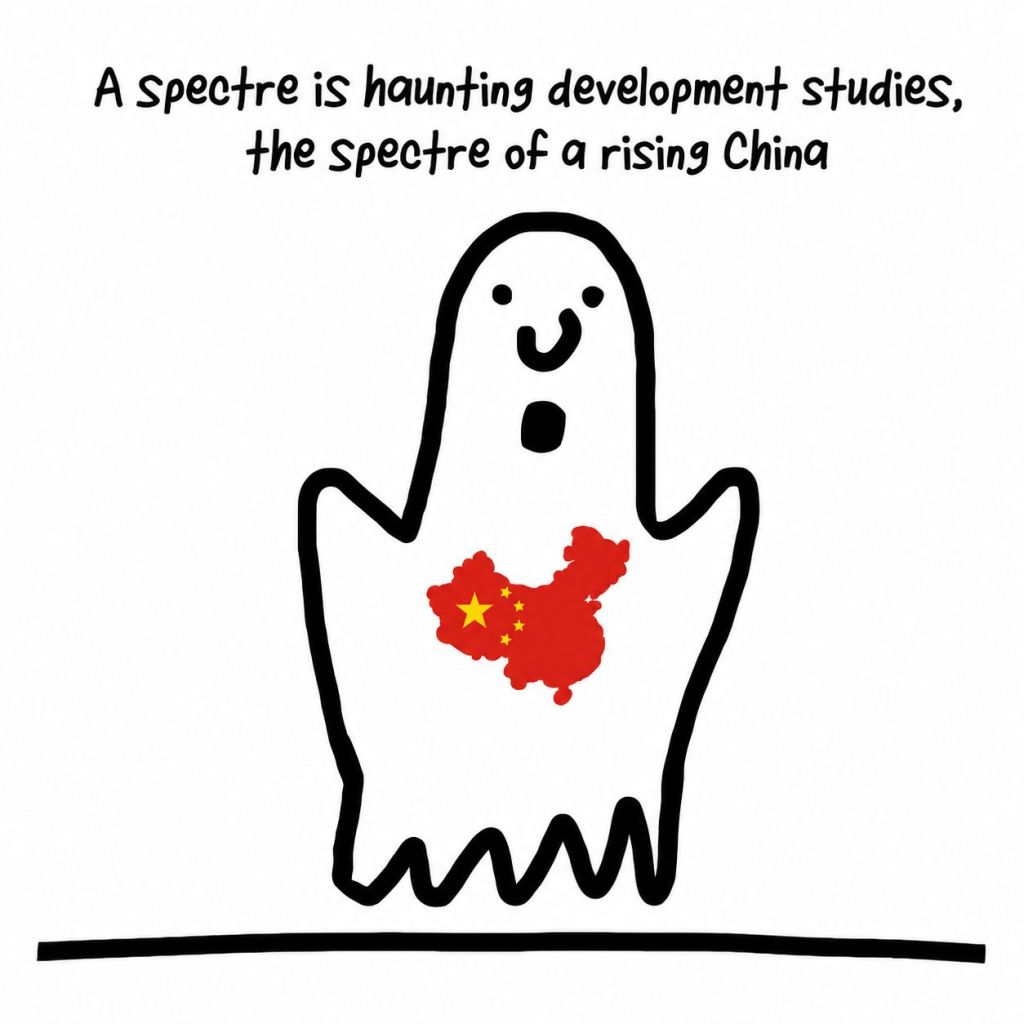
In September 2025, Adam Tooze sent a shock wave through Development studies circles (in the West) with an essay entitled “The End of Development”. He declared the evident truth that “the West’s aid model was always a mirage” and that “the UN Sustainable Development Goals now look less like a new dawn than the final gasp of a unipolar, end-of-history fantasy”. Yet, so-called ‘development’ speaks to more than aid and Western dominance. This blog post argues that what might be the end of aid could be the beginning of understanding and studying development as an endogenous process within international constraints and opportunities. For this to happen, we, as development scholars, need to resist falling back into narrow conceptions of ‘Development’ as either aid-based or big power rivalry and overcome anxious paralysis and self-pity over the end of uncontested US hegemony. Instead, we need to use the current moment as an opportunity to rethink and finally effectively conceptualise how national politics and global economic structures condition each other.
Industrial policy, once a taboo in mainstream economics, is being mainstreamed by the very institutions that spent four decades stigmatising it. In March 2026, the World Bank published Industrial Policy for Development: Approaches in the 21st Century, co-authored by Ana Margarida Fernandes and Tristan Reed. The IMF, has done a similar volte face, first in its 2019 working paper ‘The Return of the Policy That Shall Not Be Named’ and again in the October 2025 World Economic Outlook, which has a chapter titled ‘Industrial Policy: Managing Trade-Offs to Promote Growth and Resilience’. That the IMF and World Bank have now openly readmitted industrial policy into their vocabulary is no small thing. Does it mean the tide has turned on austerity and market fundamentalism?
The argument of this article is that this rhetorical turn arrives bound by two structural constraints that the new Bretton Woods literature largely refuses to confront: the ongoing rentierisation of Global South economies through IMF-World Bank conditionality, and the imperial retaliation that meets serious attempts at sovereign industrialisation. Industrial policy on the terms set by Washington and Wall Street will not free up the policy space the Global South needs; it risks becoming another financial product or technocratic buzzword layered onto an already extractive architecture.
Private credit markets are showing real signs of stress, with multiple major funds restricting withdrawals as investors struggle to exit illiquid holdings. The fears of investors in these funds, which explain the withdrawals, is driven by the success of AI, which, while driven by enormous capital spending financed in part by private credit, is perceived as disrupting the pre-existing software landscape, many of the creators of which had been financed with credit from these funds. These two dynamics are increasingly tied to military demand, with the US government encouraging private capital to build defence-linked AI infrastructure. The war on Iran is amplifying these trends by squeezing energy costs, tightening liquidity, and accelerating a shift wherein AI investment becomes less market-driven and more concentrated around state-backed priorities.
Around the 22 March 2026, two of the largest players in private credit, Apollo Global Management and Ares Management, dropped redemption gates on flagship retail credit vehicles, temporarily limiting and/or restricting investors from withdrawing their money. While investors had requested withdrawals of 11.2% and 11.6% respectively, both funds capped redemptions at 5%, leaving roughly half of requested capital locked in place.
The gating at Apollo and Ares is just one visible manifestation of broader strains across the roughly $1.8 trillion private credit market. On April 2, it was reported that Blue Owl capital had received redemption requests of upto $5.4 billion over the first quarter of 2026, with those requests amounting to 22% of its private credit fund and a much higher 41% of another of its funds target at software and technology firms. In response, Blue Owl announced a cap on redemptions of 5% of shareholder funds. Earlier BlackRock restricted withdrawals on its HPS Lending Fund, which stands at approximately $26 billion. Blackstone faced roughly $3.8 billion in redemption requests from its flagship private credit fund and stepped in with its own capital to help meet those withdrawals. Morgan Stanley saw around 11% repurchase requests in its North Haven Private Income Fund and Cliffwater honoured only about 7% of roughly 14% redemption requests.
Pakistani Prime Minister Shehbaz Sharif (third from left) at the Board of Peace’s charter announcement and signing ceremony during the World Economic Forum in January 2026 in Switzerland. Photo: Daniel Torok / White House
The recent withdrawal of the US from the United Nations Framework Convention on Climate Change (UNFCCC), the Intergovernmental Panel on Climate Change (IPCC), and other international organizations in January 2026, was preceded by the decision in COP30 Belém to have rights-based and people-centred approach to the Just Transition Mechanism in October 2025.
The US exit from the UNFCCC, the primary global treaty on climate will take full effect in a year’s time. The new attempt to define and revive a Just Transition mechanism, without US interference is considered hopeful, especially since it is linked to the Belém Action Mechanism” (BAM), an initiative which attempts to foster international cooperation, technical assistance, and capacity-building to ensure an orderly shift away from fossil fuels, and has been strongly supported by civil society and activists.
However, the new Just Transition Mechanism faces a fundamental problem: the historical conditions that made both its conception and implementation conceivable have now become obsolete. The UNFCCC bureaucracy has long operated on the pretence that imperialism does not exist, but it is now confronted with a reality in which neoliberalism has collapsed and US-led imperialism has re-emerged in an overtly militarised and increasingly fascistic form.
Neoliberalism no longer merely shortens life expectancy; it is now accelerating death rates globally through active war and warfare (see Kadri 2023). This shift is also reshaping the modalities of imperialism itself. US-led trade de-globalisation (through tariffs and EU protectionism) now coincides with a deepening of financial imperialism, marked by escalating sovereign debt crises, financial engineering, and the rapid expansion of private credit. As C.P Chandrasekhar notes, one of the likely scenario of this is that the world economy on the whole will not even have an escape route to ameliorate economic hardship and move towards a viable recovery.
In this context, the central question becomes what kind of “Just Transition” is even possible. More fundamentally, what would a genuinely people-centred Just Transition mean under these conditions?
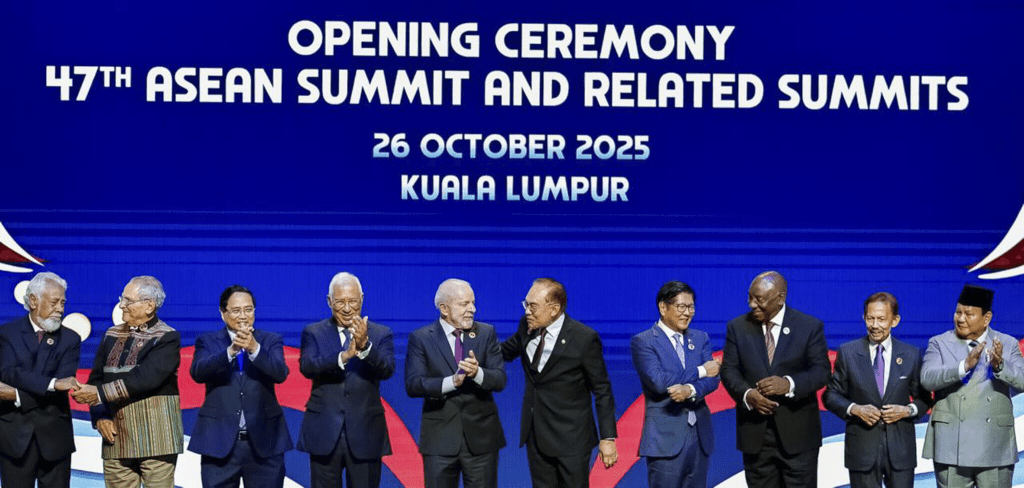
The 47th Summit of the Association of Southeast Asia Nations (ASEAN), held in Malaysia in October 2025, was a pivotal moment in the ongoing attempts by the United States to redefine the socioeconomic trajectory of Southeast Asia. While much analysis of the Summit has focused on the impact of US tariffs, there has been less attention to how these deals constrict the region’s monetary autonomy. Here we focus on the stipulations in the deals that will impose monetary subservience in Malaysia and Thailand, under the framework of ASEAN. The signing of these agreements is not a purely exogenously drive, but rather aligns with ASEAN’s historical anticommunist foundations. By deepening the region’s subordination to the United States while simultaneously expanding trade relations with China, the deals also hold implications for reconfiguring racial and class dynamics in the region.
The Shanghai Cooperation Organisation (SCO’s) 2025 summit in Tianjin produced a series of outcomes that, although modest in appearance, are strategically significant. The most prominent developments were the agreement in principle to establish an SCO Development Bank, seeded with approximately ¥2 billion in grants and a further ¥10–14 billion in concessional loans from China. The summit also saw Beijing extend access to its BeiDou satellite navigation system to member states, enhancing both civilian and defence applications from aviation and port logistics to military procurement. On the security side, leaders condemned the Pahalgam attack in India, a diplomatic win for India that underscores China’s effort to align with India at a moment when the U.S. has imposed tariffs of up to 50% on Indian exports, citing India’s purchases of Russian oil. These headline measures were complemented by renewed emphasis on counter-terrorism through RATS (the Regional Anti-Terrorist Structure) and a set of intensified SCO security-council meetings, together signalling a broadening of the organisation’s remit from finance into hard security enablers.
An additional dimension, often overlooked, is the SCO’s latent potential to serve as a platform for India–Pakistan rapprochement. Much as Beijing successfully mediated the Iran–Saudi détente in 2023, the SCO framework offers a structured environment in which India and Pakistan are compelled to engage on shared issues such as counter-terrorism, energy connectivity, and infrastructure finance, under the auspices of a formal multilateralism rather than crude bilateral confrontation. The Tianjin summit’s emphasis on regional security cooperation, and its explicit condemnation of the Pahalgam attack, is already a small step in this direction, reflecting a willingness to acknowledge Indian concerns in a joint forum. With signs that India-China relations have modestly stabilised following high-level military disengagement talks along the LAC, there is space for Beijing to use the SCO to nudge India and Pakistan toward functional cooperation. This is not purely hypothetical: emergent trilateral conversations between India, Pakistan, and Bangladesh around trade corridors and energy-grid integration suggest that South Asia’s major economies are beginning to see value in pragmatic coordination despite unresolved disputes. In this sense, the SCO could provide an institutional ecosystem for gradual confidence-building between New Delhi and Islamabad, where shared participation in multilateral projects lowers the political cost of engagement, much as regional institutions elsewhere have historically diluted bilateral rivalries.
In line with a broader shift in global governance, recent commentary by Xinhua portrays the SCO as emblematic of Eurasian agency and multipolar resonance; “a living expression of multipolarity,” bringing together diverse actors under a shared framework of non‑interference, counter‑terrorism, and connectivity. The enrolment of rivals within a single institutional ecosystem, makes the SCO, less of a confrontational bloc and closer to a practical architecture for regional autonomy and development.
Literature on the international financial architecture, has often highlighted the tension between established Western institutions and the alternative arrangements that have grown around them with much of the scholarship focusing on institutional challenges such as the creation of the Asian Infrastructure Investment Bank (AIIB) or the New Development Bank (NDB). Yet the more subtle processes of institutional layering, where new mechanisms grow alongside existing ones, gradually altering the balance of power have received far less attention.
Why do so many people who claim to “see the whole system” remain blind to power?
This question struck me while listening to a recent episode of Planet Critical. The guest was Joseph Tainter, best known for The Collapse of Complex Societies. Tainter is celebrated as a pioneer of collapse studies and systems thinking. Yet when the conversation turned to the genocide in Gaza, his framing reduced it to Israel’s “historical fear of Arabs.” The structural realities of colonialism, imperialism, and resource politics — central to understanding both Gaza and the Middle East more broadly — disappeared. Here was a thinker revered for complexity, offering an analysis that was Eurocentric, ahistorical, and politically naïve.
This is not about Tainter alone. Similar patterns appear in the work of figures like Nate Hagens and Daniel Schmachtenberger, both of whom have influenced me personally. Their mission is helping people make sense of the complex issues: Nate by weaving ecology, energy, financial systems and human behavior into accessible frameworks; Daniel by building sweeping syntheses across cognitive science, culture, and existential risk.
The often criticise most disciplines for their blindness. But their critique of blindness has its own blindness. Across their work, capitalism, imperialism, colonialism, and class power rarely appear as sustained focal points. Yes, Daniel sometimes critiques modernity and gestures toward indigenous knowledge, and Nate occasionally hosts guests who reference colonial history. But overall, the crisis is cast as a species-level problem — as though “humanity” collectively overshoots limits — rather than as the outcome of specific, historically rooted systems of exploitation with identifiable beneficiaries and victims.
In June, 1,200 scholars and activists from around the world gathered in Norway for a historic convergence of two movements: degrowth and ecological economics. During the closing plenary session, I listened to three speakers, two of whom—Kate Raworth and Max Ajl—represented radically different approaches to our current crises. Though Raworth and Ajl engaged in respectful dialogue, the tension in the room became almost palpable when Raworth’s polished slides on doughnut economics gave way to Ajl’s anti-imperialist critique: Can an apolitical reform tool truly coexist with the Global South’s demand for systemic revolution?