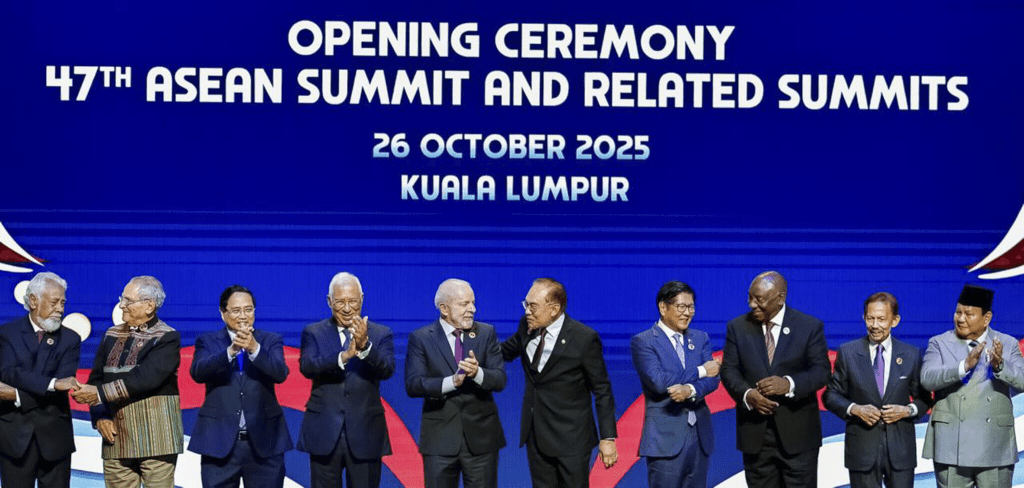
The 47th Summit of the Association of Southeast Asia Nations (ASEAN), held in Malaysia in October 2025, was a pivotal moment in the ongoing attempts by the United States to redefine the socioeconomic trajectory of Southeast Asia. While much analysis of the Summit has focused on the impact of US tariffs, there has been less attention to how these deals constrict the region’s monetary autonomy. Here we focus on the stipulations in the deals that will impose monetary subservience in Malaysia and Thailand, under the framework of ASEAN. The signing of these agreements is not a purely exogenously drive, but rather aligns with ASEAN’s historical anticommunist foundations. By deepening the region’s subordination to the United States while simultaneously expanding trade relations with China, the deals also hold implications for reconfiguring racial and class dynamics in the region.
The year 2025 will be the third consecutive year in which the Brazilian economy experiences sustained growth. During the first two years of his administration, economic expansion was above 3% annually, while the outlook for 2025 is for a slowdown: 2.4%, according to IPEA, one of Brazil’s leading state economic analysis agencies.
Since June-July 2024, during the U.S. presidential election and with the possibility of Trump being re-elected, Brazil, like other emerging economies, faced devaluation pressures. This led to higher inflation due to rising exchange rates and supply shocks caused by climate issues. These issues have reduced the food supply (mainly coffee, eggs, and beans), causing prices to rise.
This macroeconomic instability scenario was reloaded by the Trump-driven trade war, particularly when the 50% tariff on purchases from Brazil was announced under a mix of arguments between commercial (trade deficit), political (preventing Bolsonaro from being judged for an attempted coup d’état and US bigtech’s regulation), and geopolitical (the advance of the BRICS on a possible replacement of the dollar in commercial relationships).
What was the response in terms of economic policy? The institutionalization of the inflation target led to an increase in the SELIC interest rate from 10.75% in September 2024 to 15% in June 2025, the highest level since 2006. The orthodox argument suggests that raising interest rates reduces the money supply, curbing aggregate demand and reducing inflation. From another perspective, raising interest rates promotes carry trade, which attracts foreign capital through the capital account and allows the exchange rate to appreciate. In this way, the economy partially protects itself from speculative capital outflows and reduces the prices of imports and exports, thus decreasing the inflation.
In contrast, a sharp rise in interest rates deepens the pernicious effects of financialization: it impoverishes indebted families and concentrates income. Are there any other alternatives available? The economic toolbox offers other options. Many observers have noted a striking characteristic of Lula’s third administration: the absence of open confrontation with Brazil’s powerful financial sector. This is no coincidence. The painful lessons of Dilma Rousseff’s presidency (2011-2016) and her impeachment weigh heavily on current political calculations.
To understand this, we need to analyze the historical lesson of Rousseff’s removal, its macroeconomic causes, and how this experience has limited economic policy options.
The Shanghai Cooperation Organisation (SCO’s) 2025 summit in Tianjin produced a series of outcomes that, although modest in appearance, are strategically significant. The most prominent developments were the agreement in principle to establish an SCO Development Bank, seeded with approximately ¥2 billion in grants and a further ¥10–14 billion in concessional loans from China. The summit also saw Beijing extend access to its BeiDou satellite navigation system to member states, enhancing both civilian and defence applications from aviation and port logistics to military procurement. On the security side, leaders condemned the Pahalgam attack in India, a diplomatic win for India that underscores China’s effort to align with India at a moment when the U.S. has imposed tariffs of up to 50% on Indian exports, citing India’s purchases of Russian oil. These headline measures were complemented by renewed emphasis on counter-terrorism through RATS (the Regional Anti-Terrorist Structure) and a set of intensified SCO security-council meetings, together signalling a broadening of the organisation’s remit from finance into hard security enablers.
An additional dimension, often overlooked, is the SCO’s latent potential to serve as a platform for India–Pakistan rapprochement. Much as Beijing successfully mediated the Iran–Saudi détente in 2023, the SCO framework offers a structured environment in which India and Pakistan are compelled to engage on shared issues such as counter-terrorism, energy connectivity, and infrastructure finance, under the auspices of a formal multilateralism rather than crude bilateral confrontation. The Tianjin summit’s emphasis on regional security cooperation, and its explicit condemnation of the Pahalgam attack, is already a small step in this direction, reflecting a willingness to acknowledge Indian concerns in a joint forum. With signs that India-China relations have modestly stabilised following high-level military disengagement talks along the LAC, there is space for Beijing to use the SCO to nudge India and Pakistan toward functional cooperation. This is not purely hypothetical: emergent trilateral conversations between India, Pakistan, and Bangladesh around trade corridors and energy-grid integration suggest that South Asia’s major economies are beginning to see value in pragmatic coordination despite unresolved disputes. In this sense, the SCO could provide an institutional ecosystem for gradual confidence-building between New Delhi and Islamabad, where shared participation in multilateral projects lowers the political cost of engagement, much as regional institutions elsewhere have historically diluted bilateral rivalries.
In line with a broader shift in global governance, recent commentary by Xinhua portrays the SCO as emblematic of Eurasian agency and multipolar resonance; “a living expression of multipolarity,” bringing together diverse actors under a shared framework of non‑interference, counter‑terrorism, and connectivity. The enrolment of rivals within a single institutional ecosystem, makes the SCO, less of a confrontational bloc and closer to a practical architecture for regional autonomy and development.
Literature on the international financial architecture, has often highlighted the tension between established Western institutions and the alternative arrangements that have grown around them with much of the scholarship focusing on institutional challenges such as the creation of the Asian Infrastructure Investment Bank (AIIB) or the New Development Bank (NDB). Yet the more subtle processes of institutional layering, where new mechanisms grow alongside existing ones, gradually altering the balance of power have received far less attention.
In the past two decades, global health governance has undergone a quiet revolution, shaped less by sovereign states and more by the growing influence of private capital. The World Health Organisation (WHO), once envisioned as the democratic engine of international public health, has increasingly come to rely on large-scale philanthropic foundations. This shift toward what is now commonly termed “philanthrocapitalism”—where billionaire-funded entities use business strategies and methods to tackle social and environmental challenges—has profound implications. It is not just a matter of money, but of power, accountability and legitimacy. Amid what many now describe as a global health financing emergency, the WHO’s growing dependence on a handful of wealthy private actors has exposed deep cracks in the system of multilateralism upon which it was founded. Thus, philanthrocapitalism is undermining democratic global health governance by concentrating power in the hands of the wealthy and eroding public accountability.
The effectiveness of private equity has been a subject of ongoing debate in countries of the Global North. There is substantial evidence highlighting the extractive practices associated with private equity operations across Western nations. Examples include the decline of the British high street and the financial instability of local councils in the UK, particularly in the provision of child care. Similarly, in the United States, private equity has been linked to the attrition of an already fragile healthcare system. In France, Germany and the UK., its influence has contributed to the deterioration of care homes, raising significant concerns about its broader social and economic impact.
In a recent blog, Michael Roberts characterized private equity as “vampire capital“, encapsulating the widely recognized critique that private equity firms function through a rentier model. These firms are frequently associated with practices such as asset stripping, worker lay-offs, and opting for excess leverage that increases the debt burdens of their acquisitions, all while failing to provide compelling evidence of value creation. This perspective aligns closely with earlier criticisms of private equity. During the 2000s, private equity operations were similarly likened to a swarm of locusts, reflecting widespread disapproval of their extractive and often detrimental economic practices.
In summary, such analogies emphasize the aftermath of private equity operations, leaving behind “carcasses and barren landscapes.” Nevertheless, the evidence of a hollowed-out socio-economic landscape in the Global North has not deterred the international expansion of private equity into countries of the Global South. On the contrary, ongoing reports of American private equity capturing British markets have emerged in tandem with the globalization of Western private equity. In so-called “emerging markets,” this expansion manifests in various forms, including an enthusiasm for deploying “moral money” through international development initiatives.
This article examines the role of private equity in Global South countries, focusing on three key characteristics: the escalation of indebtedness, the weakening of public markets, and the public subsidy function of development finance in facilitating private equity investments.
In 2009, I was interested in studying the phenomenon of M-Pesa as a legal scholar—just a year after its launch and intense rollout. My standpoint enabled me to see the initial regulatory paradoxes that M-Pesa presented. In 2010, I began my PhD, exploring what a regulatory framework should look like. My analysis focused on the complexities presented by the storage and transfer of customer funds within mobile money systems. Central to my analysis were themes of financial regulation, consumer rights, financial stability, conceptualising ‘financial inclusion’, and the meaning of ‘banking the unbanked’. At the time, the study was significant, in understanding the contractual tensions between mobile money users and Safaricom, a non-bank entity, which provided services akin to a traditional bank’s deposit system—yet did not appear to be subject to the same regulatory restraints as conventional banks. Crucially, banks and financial institutions had historically dominated much of the financial system, through exclusionary practices due to colonialism. Therefore, M-Pesa caused much upheaval to established banks, but simultaneously provided hope for the excluded. Various actors extended this new hope, in the ‘success’ narrative of M-Pesa. Its beneficial use as a storage and transfer system was extolled as alleviating poverty, and the restatement of its trajectory was and continues to be modelled across the developing world. The global development and digitalisation agenda have subsumed M-Pesa’s pervasive influence, both valorising the pathways to ‘development’ and ‘innovation’ through FinTech with a singular aim of ‘financial inclusion.’
As a result, Kenya has become the site of contestation for overwhelming empirical research, interest, and knowledge production, particularly by Western scholars and institutions. A ‘gold rush’ has emerged, and the scramble for knowledge extraction has intensified across academic disciplines and across methodologies. Studies from Ghana, Senegal and Kenya dominate. The study of ‘development’ in all its iterations has gained a new development. However, much of the ways in which mobile money (M-Pesa) and FinTech are discussed and framed demonstrates a Western understanding of the everyday lives of the Kenyans who use it. Scholars, activists, and proponents often situate the premise of its use as being between two paradigms: advancing financial inclusion through the enhancement of global development aims, and its function as a tool that includes Kenyans in extractive cycles of financialisation. Both of these are true.
I came to the study of fintech as a feminist socio-legal scholar researching the gender dynamics of South-South migration. While doing fieldwork in Kenya for my PhD in 2012, I came across M-Pesa, a mobile money service used by locals as an instrument for transferring money from urban to rural areas. From the start of my research in 2011 to the completion of my PhD in 2016, ongoing studies on M-Pesa were mainly celebratory. It was acclaimed as an innovative instrument for poverty reduction, development, and gender equality and was enthusiastically supported by donors and international financial institutions such as the World Bank and the International Monetary Fund (IMF), as well as by tech entrepreneurs and corporate philanthropy. Its success story was so uncontested that I decided to change my research question to focus on the gender dynamics of digital financial inclusion, rather than on my initial interest, migration.
The key narrative of M-Pesa’s success in terms of gender equality was, and still is, that it facilitates women’s access to financial services, providing them with a variety of opportunities to improve their own livelihoods and those of their families, their communities, and ultimately their countries. In the specific case of M-Pesa, a basic-mobile-phone-enabled money transfer service is considered more accessible and available than transferring money via mainstream financial institutions such as banks, and more reliable and secure than informal finance channels such as moneylenders or the handling of cash via rotating credit and savings associations (ROSCAs). This claim is based on three assumptions: first, that women have less access to financial services than men have; second, that women would use their access to finance to support not only themselves but also their families and communities; and third, that digital financial services are better than informal financial channels because they overcome the limits of cash, ensuring traceability and security. These assumptions motivated advocacy and investment in digital financial inclusion projects and the creation of ad hoc programmes and institutions, all strongly focused on the question of how digital technology can be used to facilitate women’s access to financial services.
Over the last few years ‘decolonisation’ has become an increasingly popular subject in Western academia. Broadly considered the process of recognising and undoing the intellectual and institutional structures that enabled and maintain the reproduction of imperial power, calls for decolonisation have opened uncomfortable debates about epistemological privilege, forcing us to confront biases and injustices and to revisit hidden histories and visions for the future. While these debates remain essential, particularly at a time of political authoritarianism, racism, and violence, they also highlight the contradictions in Western academia between decolonisation as a fashionable conceptual trend and its real commitment to justice.
In formerly colonised communities, generational consciousness of colonial oppression and struggles to recover land, property, wealth, and political institutions have created a lived experience of the long-term consequences of colonialism, usually conceptualised as ‘coloniality’, that is not a concept but a reality. This experience has shaped movements and protests in the Global South, including within universities. An example is the #FeesMustFall movement in South Africa, which followed the significant decline of government subsidisation of universities with discriminatory consequences for the disadvantaged Black population without historical wealth and economic privilege. Similar protests concern the recognition of and fight against pillars of colonial power including philanthropists such as British colonialist Cecil Rhodes, who accumulated wealth by appropriating land, enslaving people and extracting resources, and used that wealth to shape knowledge production.
Other significant protests involve resistance against neocolonial powers such as Western financial infrastructures, corporations and international institutions i.e. the International Monetary Fund (IMF) and the World Bank. A recent example is the ongoing youth-led (Gen Z) round of protests in Kenya #rejectfinancebill2024, motivated by demands to reject the IMF-supported Finance Bill that, if approved, would have imposed a fresh round of government cuts to basic services and austerity measures on Kenyans. The young people protesting in the streets of Nairobi showed awareness of the colonial legacy and long-term impact of the 1980s structural adjustment policies (SAPs) on the lives of people – particularly those at the lower end of the income distribution, and demanded economic sovereignty as the only way to achieve social justice. The protests were successful in impeding the adoption of the Bill, but many young people paid with their lives, as the government deployed a deadly military response to the protests.
The demands for decolonisation are based on ending economic and epistemological oppression, two interrelated aims, each grounded in colonialism. Reclaiming knowledge and the economic means that allow its production and dissemination has always been at the centre of decolonisation as an opportunity to remake societies, nations, and the world itself for the better. In its fight for justice, decolonisation is a grassroots struggle against colonial and neo-colonial rulers and rules, as well as against all global and local actors and structures that enable and reinforce those rules. For this reason, grassroots voices need to be at the centre of any decolonisation project.


 Developing Economics