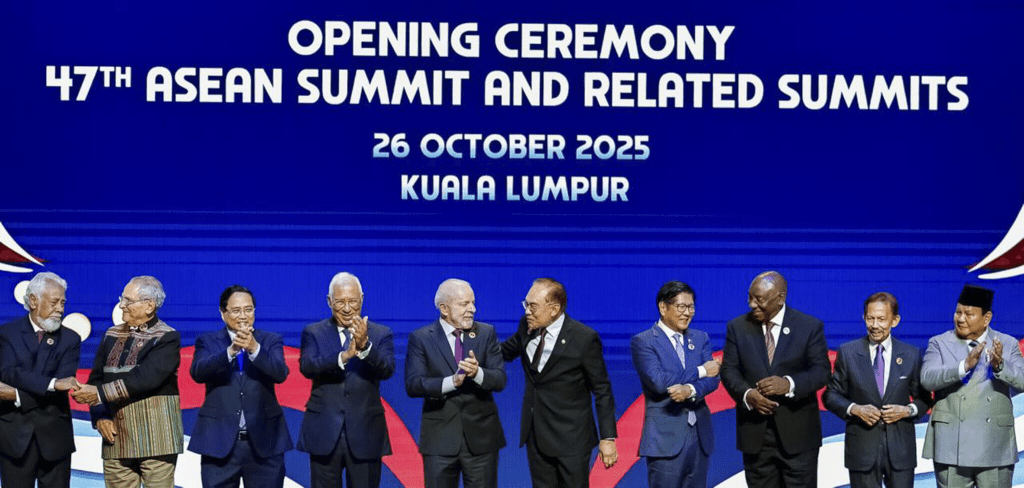
ASEAN Summit 2025: Imperialism, Monetary Subservience, and Racial/Class Divisions

By Farwa Sial and Fadiah Nadwa Fikri

The 47th Summit of the Association of Southeast Asia Nations (ASEAN), held in Malaysia in October 2025, was a pivotal moment in the ongoing attempts by the United States to redefine the socioeconomic trajectory of Southeast Asia. While much analysis of the Summit has focused on the impact of US tariffs, there has been less attention to how these deals constrict the region’s monetary autonomy. Here we focus on the stipulations in the deals that will impose monetary subservience in Malaysia and Thailand, under the framework of ASEAN. The signing of these agreements is not a purely exogenously drive, but rather aligns with ASEAN’s historical anticommunist foundations. By deepening the region’s subordination to the United States while simultaneously expanding trade relations with China, the deals also hold implications for reconfiguring racial and class dynamics in the region.

Read More »

New World Order against Tariffs: SCO Development Bank as an anti-sanctions tool?

The Shanghai Cooperation Organisation (SCO’s) 2025 summit in Tianjin produced a series of outcomes that, although modest in appearance, are strategically significant. The most prominent developments were the agreement in principle to establish an SCO Development Bank, seeded with approximately ¥2 billion in grants and a further ¥10–14 billion in concessional loans from China. The summit also saw Beijing extend access to its BeiDou satellite navigation system to member states, enhancing both civilian and defence applications from aviation and port logistics to military procurement. On the security side, leaders condemned the Pahalgam attack in India, a diplomatic win for India that underscores China’s effort to align with India at a moment when the U.S. has imposed tariffs of up to 50% on Indian exports, citing India’s purchases of Russian oil. These headline measures were complemented by renewed emphasis on counter-terrorism through RATS (the Regional Anti-Terrorist Structure) and a set of intensified SCO security-council meetings, together signalling a broadening of the organisation’s remit from finance into hard security enablers.

An additional dimension, often overlooked, is the SCO’s latent potential to serve as a platform for India–Pakistan rapprochement. Much as Beijing successfully mediated the Iran–Saudi détente in 2023, the SCO framework offers a structured environment in which India and Pakistan are compelled to engage on shared issues such as counter-terrorism, energy connectivity, and infrastructure finance, under the auspices of a formal multilateralism rather than crude bilateral confrontation. The Tianjin summit’s emphasis on regional security cooperation, and its explicit condemnation of the Pahalgam attack, is already a small step in this direction, reflecting a willingness to acknowledge Indian concerns in a joint forum. With signs that India-China relations have modestly stabilised following high-level military disengagement talks along the LAC, there is space for Beijing to use the SCO to nudge India and Pakistan toward functional cooperation. This is not purely hypothetical: emergent trilateral conversations between India, Pakistan, and Bangladesh around trade corridors and energy-grid integration suggest that South Asia’s major economies are beginning to see value in pragmatic coordination despite unresolved disputes. In this sense, the SCO could provide an institutional ecosystem for gradual confidence-building between New Delhi and Islamabad, where shared participation in multilateral projects lowers the political cost of engagement, much as regional institutions elsewhere have historically diluted bilateral rivalries.

In line with a broader shift in global governance, recent commentary by Xinhua portrays the SCO as emblematic of Eurasian agency and multipolar resonance; “a living expression of multipolarity,” bringing together diverse actors under a shared framework of non‑interference, counter‑terrorism, and connectivity. The enrolment of rivals within a single institutional ecosystem, makes the SCO, less of a confrontational bloc and closer to a practical architecture for regional autonomy and development.

Literature on the international financial architecture, has often highlighted the tension between established Western institutions and the alternative arrangements that have grown around them with much of the scholarship focusing on institutional challenges such as the creation of the Asian Infrastructure Investment Bank (AIIB) or the New Development Bank (NDB). Yet the more subtle processes of institutional layering, where new mechanisms grow alongside existing ones, gradually altering the balance of power have received far less attention.

Read More »

Systems Thinking, Polycrisis, and the Blind Spot of Power

Why do so many people who claim to “see the whole system” remain blind to power?

This question struck me while listening to a recent episode of Planet Critical. The guest was Joseph Tainter, best known for The Collapse of Complex Societies. Tainter is celebrated as a pioneer of collapse studies and systems thinking. Yet when the conversation turned to the genocide in Gaza, his framing reduced it to Israel’s “historical fear of Arabs.” The structural realities of colonialism, imperialism, and resource politics — central to understanding both Gaza and the Middle East more broadly — disappeared. Here was a thinker revered for complexity, offering an analysis that was Eurocentric, ahistorical, and politically naïve.

This is not about Tainter alone. Similar patterns appear in the work of figures like Nate Hagens and Daniel Schmachtenberger, both of whom have influenced me personally. Their mission is helping people make sense of the complex issues: Nate by weaving ecology, energy, financial systems and human behavior into accessible frameworks; Daniel by building sweeping syntheses across cognitive science, culture, and existential risk.

The often criticise most disciplines for their blindness. But their critique of blindness has its own blindness. Across their work, capitalism, imperialism, colonialism, and class power rarely appear as sustained focal points. Yes, Daniel sometimes critiques modernity and gestures toward indigenous knowledge, and Nate occasionally hosts guests who reference colonial history. But overall, the crisis is cast as a species-level problem — as though “humanity” collectively overshoots limits — rather than as the outcome of specific, historically rooted systems of exploitation with identifiable beneficiaries and victims.

Read More »

The Doughnut and the Divide: Can Norway Confront Its Imperial Mode of Living?

In June, 1,200 scholars and activists from around the world gathered in Norway for a historic convergence of two movements: degrowth and ecological economics. During the closing plenary session, I listened to three speakers, two of whom—Kate Raworth and Max Ajl—represented radically different approaches to our current crises. Though Raworth and Ajl engaged in respectful dialogue, the tension in the room became almost palpable when Raworth’s polished slides on doughnut economics gave way to Ajl’s anti-imperialist critique: Can an apolitical reform tool truly coexist with the Global South’s demand for systemic revolution?

Read More »

COOPT, EMPTY, EVISCERATE: Nievas and Piketty on Unequal Exchange

By Güney Işıkara and Patrick Mokre

The recent paper by Gastón Nievas and Thomas Piketty, “Unequal Exchange and North-South Relations” has gained substantial praise as well as criticism in a short period of time. Their empirical endeavor is impressive: the authors compiled and published a large dataset of balance of payments, including traded goods, services, direct transfers, and income from foreign labor and capital assets. This is a gruelling task in itself, and the dataset will certainly provide the foundations for many fruitful studies. For many academic economists, Nievas and Piketty’s own interpretation of the data constitutes one such great contribution for it puts forward, as the title of their paper suggests, that modern inequalities across regions and countries have their roots in colonial extraction and unequal exchange characterizing international trade until today. 

We on the other hand argue that the paper falls behind the state of perception of international inequalities in the Marxist tradition, dependency and structural economics literature. It (1) grasps global inequality as the outcome of a collection of distortions of the capitalist market mechanism rather than as an intrinsic feature of the latter; (2) consequently, proposes structural reforms to alter the power asymmetries in international trade, without an appropriate model of those power relations and why they exist in the first place; (3) lacks an adequate theory of production, value and price to understand the exchange relations at stake; and (4) artificially separates the term unequal exchange from the existing literature on trade inequalities, value transfers, and drain of wealth.  

Read More »

Back to the White Elephants – the West’s new development strategy in Africa

“Europe’s new external investment strategy needs to reconnect with historical business models we are going back to white elephants of 1970s – because that’s what partners want

– G7 official in a speech on Trade and Finance.

The era of Western dominance has indeed definitely ended

– Josep Borrell (2024), High Representative of the European Union for Foreign Affairs and Security Policy / Vice-President of the European Commission. [1]

On 28 January 2024, three members of the Economic Community of West African States (ECOWAS), Niger, Mali and Burkina Faso, announced their withdrawal from ECOWAS.  Created in 1974, ECOWAS is a regional economic community serving as a large trading bloc, to enhance the regional integration and economic cooperation of its 15 member countries.  The three countries’ decision to leave the trade-bloc so forthrightly, was related to a series of ECOWAS-imposed sanctions on their military governments and the countries’ objection to French influence in the bloc.[2] Long-standing dissatisfaction with the ECOWAS was also an overarching factor; member countries include some of the most resource-rich nations, but on the whole members barely made any progress on socio-economic indicators linked to the ECOWAS promise of prosperity through regional integration.

Political uncertainty in the trade-bloc further deteriorated in mid-February 2024, when the Senegalese President Macky Sall, unilaterally postponed the country’s presidential elections and was later ousted. Faced with such existential challenges, ECOWAS lifted sanctions on Niger and other countries within a month of their imposition. While the potential breakdown of ECOWAS and the general trajectory of some African countries into authoritarianism, may not seem like a radical shift in the continent’s history, the incendiary global context, which compelled ECOWAS to lift sanctions is unprecedented. The neo-colonial drivers of the current crumbling political order in Sudan and the Congo as well as the ongoing genocide in Palestine, indelibly expose the reality that we are entering into an era of naked colonial violence. Backlash to US-centred imperialism is growing. In March 2024, Niger suspended all military relations with the US, citing issues related to US encroachment upon its sovereignty.[3] Embedded in this evolving situation, the episodic and ad-hoc de-linking of Global South countries from Global North countries and their dominance in blocs such as the ECOWAS is representative of a broader shift in Africa’s resistance against political and economic subordination to G7 countries.

Against this background, the Western powers’ new and evolving development strategy in Africa offers important insights into how the G7 countries are failing to register the transformative changes in Africa. [4] In a closed-door speech on investment, trade and finance forum, a G7 official described Europe’s new external investment strategy as one that harkens back to the White elephants of the 1970s. While the speaker was using the term ‘White Elephant’ to signify the EU’s interest in funding hard infrastructure, imbued with a promise of investment and growth for recipient countries, he clearly failed to grasp its meaning. A ‘white elephant’ is an overly expensive infrastructure asset, which fails to generate value for the economy.

Considered in light of the correct definition of the term, the West’s new development strategy does seem to be going towards expensive infrastructure projects, spurred by a reactionary, performative but ultimately imagined competition with China. I make this point through a comparative analysis between the G7s contemporary development strategy vis-à-vis the Chinese development model as it unfolds within the broader demise of US-led imperialism.

Read More »

On recentring women’s grassroots struggles to decolonise FinTech narratives

Drawing realised by artist Pawel Kuczyński for Serena Natile’s book The Exclusionary Politics of Digital Financial Inclusion: Mobile Money, Gendered Walls

I came to the study of fintech as a feminist socio-legal scholar researching the gender dynamics of South-South migration. While doing fieldwork in Kenya for my PhD in 2012, I came across M-Pesa, a mobile money service used by locals as an instrument for transferring money from urban to rural areas. From the start of my research in 2011 to the completion of my PhD in 2016, ongoing studies on M-Pesa were mainly celebratory. It was acclaimed as an innovative instrument for poverty reduction, development, and gender equality and was enthusiastically supported by donors and international financial institutions such as the World Bank and the International Monetary Fund (IMF), as well as by tech entrepreneurs and corporate philanthropy. Its success story was so uncontested that I decided to change my research question to focus on the gender dynamics of digital financial inclusion, rather than on my initial interest, migration.

The key narrative of M-Pesa’s success in terms of gender equality was, and still is, that it facilitates women’s access to financial services, providing them with a variety of opportunities to improve their own livelihoods and those of their families, their communities, and ultimately their countries. In the specific case of M-Pesa, a basic-mobile-phone-enabled money transfer service is considered more accessible and available than transferring money via mainstream financial institutions such as banks, and more reliable and secure than informal finance channels such as moneylenders or the handling of cash via rotating credit and savings associations (ROSCAs). This claim is based on three assumptions: first, that women have less access to financial services than men have; second, that women would use their access to finance to support not only themselves but also their families and communities; and third, that digital financial services are better than informal financial channels because they overcome the limits of cash, ensuring traceability and security. These assumptions motivated advocacy and investment in digital financial inclusion projects and the creation of ad hoc programmes and institutions, all strongly focused on the question of how digital technology can be used to facilitate women’s access to financial services.

Read More »

Anti-Colonial Solutions to climate change

When we discuss the climate crisis in economics, we are often confronted with a debate resting on technical solutions, emissions paths, and energy use: a certain amount of time to go from coal to turbines means a certain amount of carbon dioxide emitted, which means a certain likely degree of global temperature change. In environmental economics, climate change and its associated environmental problems are often framed as ‘externalities’; that is, unfortunate and unintended spillovers caused by market mechanisms. Often, social issues are taken into account within this narrative through sunny phrases like “sustainable development” or “just transition.” The responsible parties are often individuals, states, or firms that are often thought to take action within the market. What does this debate look like if we take two different questions as starting points: not how to solve the climate crisis through market mechanisms and regulation, but how to solve the climate crisis while attending to the colonial legacy and exiting from contemporary neo-colonial accumulation patterns? Let us take a look.

Read More »