By Farwa Sial and Fadiah Nadwa Fikri
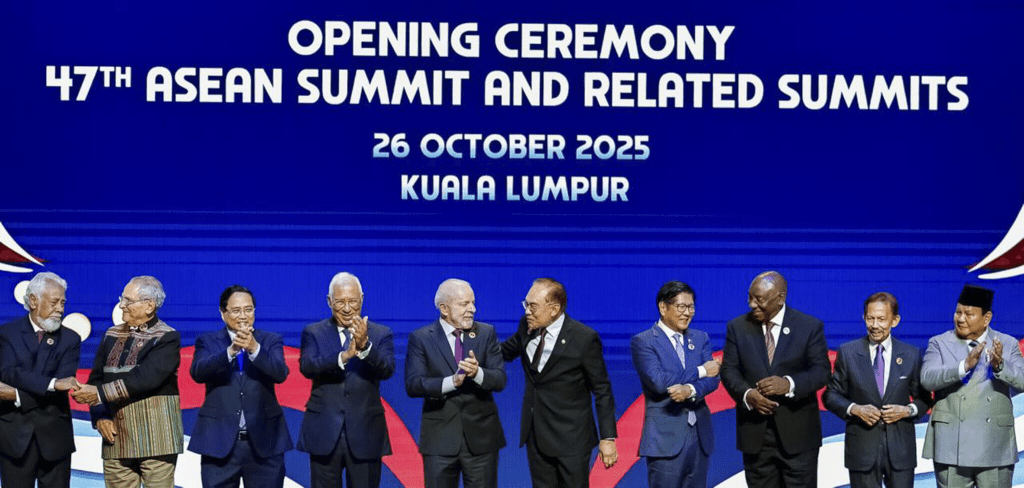
The 47th Summit of the Association of Southeast Asia Nations (ASEAN), held in Malaysia in October 2025, was a pivotal moment in the ongoing attempts by the United States to redefine the socioeconomic trajectory of Southeast Asia. While much analysis of the Summit has focused on the impact of US tariffs, there has been less attention to how these deals constrict the region’s monetary autonomy. Here we focus on the stipulations in the deals that will impose monetary subservience in Malaysia and Thailand, under the framework of ASEAN. The signing of these agreements is not a purely exogenously drive, but rather aligns with ASEAN’s historical anticommunist foundations. By deepening the region’s subordination to the United States while simultaneously expanding trade relations with China, the deals also hold implications for reconfiguring racial and class dynamics in the region.
ASEAN: A Hub for Limiting Communism in East Asia
ASEAN was formed in August 1967 by five countries: Malaysia, Indonesia, the Philippines, Singapore, and Thailand. Other countries were gradually added to the membership, most recently East Timor, which in 2025 became the eleventh member. The foundation of ASEAN was based on the ASEAN Declaration, which affirmed the formation of the platform reflected the ethos of regional solidarity. It declared that ASEAN represents “the collective will of the nations of Southeast Asia to bind themselves together in friendship and cooperation and, through joint efforts and sacrifices, secure for their peoples and for posterity the blessings of peace, freedom and prosperity.”
What this ethos conceals is the myriad ways that the association has historically been instrumentalized by its proponents in the service of American interests to reinforce neocolonialism—which Kwame Nkrumah identified as “the last stage of imperialism”—driven by anticommunism.
ASEAN, founded in the midst of the Vietnam War, was conceived as a regional economic project that would seek alternatives to the strong wave of anti-imperialism and communist guerilla movements in Southeast Asia. Although the United States suffered a humiliating defeat with the victory of the Vietnamese national liberation movement in 1975, the US partnership with East Asian comprador elites continued. This partnership was evident in the military and economic alliances forged by the leading imperialist power and the founding members of ASEAN countries.
The Philippines, which hosts US military bases to this day, started to form these relations with the United States as early as the end of the Second World War. has maintained similar ties since 1950. Indonesia, run by right-wing military leaders following a so-called “coup attempt” against the Sukarno government in 1965, broke diplomatic relations with China and moved to strengthen its relationship with the United States. The supposed coup resulted in the anticommunist massacres of 1965–66, in which thousands of alleged members of the Indonesian Communist Party were killed. The US Central Intelligence Agency recommended this method as “as a model for future operations.”
The collaboration of Malaysia and Singapore with the US imperial power spanned from the late 1950s to the mid-1960s. The neocolonial Malay ethnostate was molded by the British as a racializing project aimed at containing communism in the region—a structure that persisted after the formal independence of Malaya in 1957 and was further reinforced with the formation of Malaysia in 1963. As General John Harding, Commander-in-Chief of Britain’s Far East Land Forces stressed: “This whole thing in Malaya lies in the defense of the frontier of Indochina, and Malaya is very closely interlocked with this and cannot be separated.”
In a similar vein, US President John F. Kennedy’s director of intelligence and research, Roger Hilsman, affirmed that the formation of Malaysia in 1963 “would complete a wide anticommunist arc enclosing the entire South China Sea.” The leadership of Tunku Abdul Rahman, Malaysia’s first prime minister, was strongly anticommunist. Expressing its total support for the US, Malaysia sent arms to Vietnamese comprador leader Ngo Dinh Diem to suppress the national liberation movement’s resistance to US imperialism in Vietnam—a move which violated the 1954 Geneva Agreement.
Admitting to this heinous act, Tunku Abdul Rahman unabashedly revealed to the newspaper the Star:
I was so impressed with this man [Ngo Dinh Diem] that when the fight against the communists ended (in Malaysia) in July 1960 I decided to send to him, which I now confess openly, all the arms and war materials and equipment we used against the communists. At the time I denied doing so when tackled because it was against the terms of the Geneva Agreement.
In addition, Malaysia emulated the British counterinsurgency playbook by training South Vietnamese officers in counterinsurgency and police administration. It also permitted US combat troops in Vietnam to use Malaysian soil as a leave base for “Rest and Recreation.”
With the fall of the Soviet Union in 1991, the membership of Laos and Cambodia to ASEAN in the late 1990s, and the Asian Financial Crisis 1997–98, ASEAN transformed in many ways. From a nodal hub which helped steer and regionalize Japanese and Western capital in East Asia to a region competing for investment in international markets since the 2000s, East Asian regionalism is ultimately centered on an investment-driven agenda accompanying defense interests.
Today this fact determines ASEAN’s economic partnerships. While China is ASEAN’s largest trade partner, followed by the US in the second place, ultimately the region’s alliances are primarily molded by their subjugation to American imperialism, tempered by economic alliances with China. Under the ASEAN-China Free Trade Agreement (ACFTA) 3.0 , China’s economic footprint in the region may offer room for maneuver to counter these developments. However the immediacy of exorbitant tariffs and central bank surveillance means a series of new hardships for the region’s poorest populations. ASEAN’s historical alignment with the United States is currently being reshaped with the new bilateral agreements between the US and East Asian countries. These deals, forged at the 2025 Summit, functionally extend America’s historical legacy in the region by directly constricting monetary policy, as exemplified by the pivotal US arrangements with Malaysia and Thailand.
Mini–Plaza Accords? The 2025 US-Malaysia and US-Thailand Agreements
In October 2025, Bank Negara Malaysia (the Central Bank of Malaysia) announced that it would begin sharing semiannual foreign exchange data with the US Treasury, as part of the US-Malaysia deal. This statement was cloaked in the familiar bureaucratic language of “transparency” and “good governance.” For the first time, Washington will receive a delayed but detailed view of how and when Kuala Lumpur defends the ringgit. The move comes alongside a parallel agreement with the Bank of Thailand, and together they signal the emergence of what might be called a series of modern “mini–Plaza Accords”: arrangements that update the logic of the 1985 Plaza Accord, for a world in which the United States continues to deepen its rule through audit.
Unlike the spectacle of the original Plaza meeting, these new accords do not formally dictate exchange-rate realignments but rather achieve compliance through surveillance. The governments view their participation not only as a way of avoiding the (largely rhetorical) stigma of being labelled “currency manipulators,” but as a means of preserving their own domestic hierarchies.
The timing of these mini-Plazas is no coincidence. Across the Global South, the dollar’s supremacy is under challenge. China and Russia now settle a significant part of their trade in their own currencies; BRICS members are considering building new clearing systems; and central banks across the global South are considering diversifying their reserves. By binding Malaysia and Thailand into permanent data-exchange relationships, the US Treasury is keen to ensure that any regional shift toward renminbi settlement remains observable and, by extension, punishable.
The American ability to impose penalties on central banks completes the picture. Once a central bank begins sharing detailed foreign exchange data with the US Treasury, the bank effectively enters the orbit of the Office of Foreign Assets Control. Aggregated transaction data, even with a time lag, provides Washington with the intelligence needed to detect sanction-evasion patterns. Malaysia’s financial system sits astride trade routes linking China, Iran, and Russia; its banks clear vast amounts of dollar-denominated trade. Under the new framework, Malaysia cannot easily plead neutrality. The awareness that Treasury analysts are watching will ensure that banks over-comply and that regulators self-censor. Sanctions enforcement thus becomes decentralized and invisible, accomplished not through threats but through anticipation of scrutiny and discipline.
The logic resembles the hard dollarization experiment unfolding in Argentina under Javier Milei. There, sovereignty is being surrendered openly, with the promise that adopting the US currency will deliver stability. Malaysia and Thailand offer a softer version of the same faith. They retain their own currencies but outsource discretion, turning their central banks into reporting agents and effectively “financial intelligence units” within the wider dollar system. The difference between Argentina and Malaysia is one of degree rather than kind, since both subscribe to a theology that equates dependence with economic progress.
For Southeast Asia, the implications are profound. Singapore has long been Washington’s principal compliance hub; now Malaysia and Thailand are being woven into the same enforcement matrix, ensuring that ASEAN’s financial channels remain clean of transactions deemed suspicious by Western standards. Indonesia and Vietnam, as their ties with China deepen, will face similar pressure. What appears to be a benign commitment to data-sharing is in fact the construction of a regional hierarchy of compliance. The governments of Malaysia and Thailand have conscripted themselves, seeking safety in the very structure that limits them.
Reconfiguring Dynamics of Race and Class
The quiet reorganization of Southeast Asia’s monetary sovereignty through the US-Malaysia and US-Thailand agreements holds several implications for the racial and class order in the region. In Malaysia this is most visible in the racial diversity of its population, while in Thailand the patronage system crosses across the commercial bourgeois and monarchy-linked bureaucracy.
In Malaysia, the ruling coalition remains dependent on the longstanding Bumiputera policy, a system of economic preferences for Malays (which, at the level of formal designation, purports to include the Orang Asli and the Indigenous peoples of East Malaysia) that ensures the survival of its political base. The rise of the renminbi as a regional settlement currency threatens to reconfigure those hierarchies by empowering Chinese-diaspora networks that already dominate much of the private economy. A renminbi-centered trading bloc would enhance their access to capital and connections to mainland China, potentially undermining the Bumiputera order. For the Malaysian elite, therefore, entrenching the country more firmly in the dollar system is not merely prudent macroeconomics but also acts as a strategy of class and ethnic preservation.
In Thailand, the monarchy and its allied bureaucracy face a comparable calculus. The kingdom’s economy has long been structured around export industries settled in dollars, and its establishment fears that a yuan-based regional order would shift power towards a Chinese-Thai commercial bourgeoisie that sits outside the traditional patronage system. Aligning more closely with Washington reassures investors, maintains access to dollar liquidity, and secures the old order’s position, while simultaneously precluding alternative capital formations and concentrations. These are not reluctant vassals but rather local oligarchies quite transparently seeking refuge in their preferred hegemon’s shadow.
Conclusion
The 2025 ASEAN Summit and the subsequent US-Malaysia and US-Thailand trade agreements are the latest manifestation of a long historical trajectory. ASEAN, founded on an anticommunist bedrock and historically a bulwark for US interests in the region, continues to facilitate a neocolonial framework that compromises national sovereignty for elite stability. The mini–Plaza Accords exemplify this dynamic, replacing the overt coercion of the past with a sophisticated architecture of surveillance and voluntary compliance.
East Asian governments also struggle with responding to the popular anti-Zionist and anti-imperialist sentiment shared by their populations, as they compete for investments and contracts and bargain for lowered tariffs from the United States. In this context, their positions on Palestine are representative of how the past, present, and future converge under imperialism. Malaysia’s stance on settler colonialism in Palestine exemplifies this. In 1956, Tunku Abdul Rahman openly sought to establish diplomatic relations with Israel. He later reversed this move due to strong public opposition, particularly from Malay Muslims, the dominant population of Malaysia and the core of the neocolonial ethnostate project. This structural alignment with Western imperialist powers persists into the present. Even as the Malaysian state offers rhetorical support for Palestine today, it maintains its relations with Israel under the auspices of the United States. In May 2024, the government signed a $80 million agreement with Lockheed Martin and hosted Israeli-linked arms manufacturers, including Lockheed Martin and BAE Systems, at a defense trade exhibition in Kuala Lumpur. In November 2024, it allowed the USS Abraham Lincoln warship to dock at Port Klang. The warship was part of Operation Prosperity Guardian to protect Israeli interests in the Red Sea against the Yemeni resistance. The story is similar across the region.
Farwa Sial is a Research Associate at the Department of Economics, School of Oriental and African Studies (SOAS).
Fadiah Nadwa Fikri is a human rights lawyer and member of the Center to Combat Corruption and Cronyism, an independent non-profit organisation fighting corruption in Malaysia.
 Developing Economics
[…] Disclaimer: This story is auto-aggregated by a computer program and has not been created or edited by budgetbuddy.Publisher: Source link […]
LikeLiked by 1 person