In September 2025, Adam Tooze sent a shock wave through Development studies circles (in the West) with an essay entitled “The End of Development”. He declared the evident truth that “the West’s aid model was always a mirage” and that “the UN Sustainable Development Goals now look less like a new dawn than the final gasp of a unipolar, end-of-history fantasy”. Yet, so-called ‘development’ speaks to more than aid and Western dominance. This blog post argues that what might be the end of aid could be the beginning of understanding and studying development as an endogenous process within international constraints and opportunities. For this to happen, we, as development scholars, need to resist falling back into narrow conceptions of ‘Development’ as either aid-based or big power rivalry and overcome anxious paralysis and self-pity over the end of uncontested US hegemony. Instead, we need to use the current moment as an opportunity to rethink and finally effectively conceptualise how national politics and global economic structures condition each other.
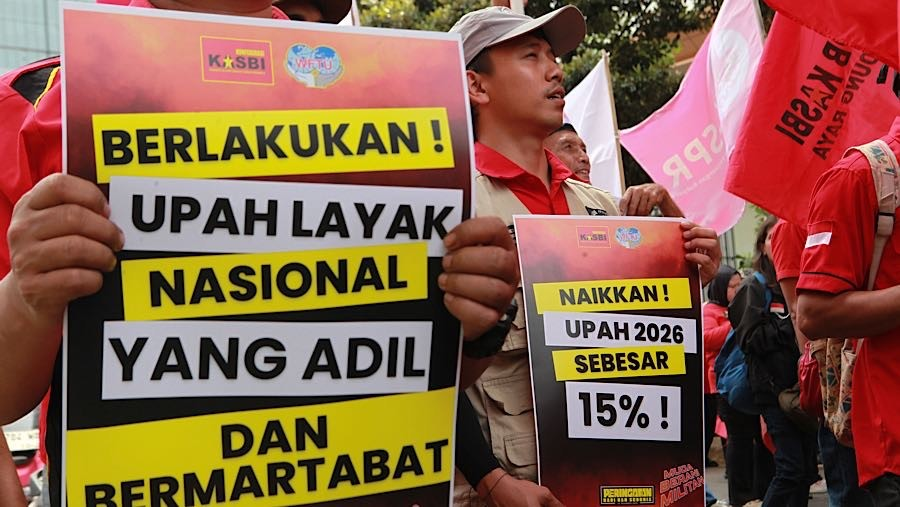
What actually constitutes the key agenda for workers in Indonesia beyond celebrating May Day as a symbol of struggle? Wages in Indonesia are never truly “negotiated”; they are determined, stabilized, and at the same time separated from the political power that should be able to challenge them. Since the authoritarian New Order regime, the state has built a corporatist framework that not only suppresses independent worker organizations but also fragments the possibility of forming an effective collective force. Reformasi did open space for freedom of association, yet instead of producing consolidation, what emerged was fragmentation—many unions, but weak and divided. Thus, when integrated into global value chains, this configuration finds its function: the state no longer needs to repress workers overtly; it suffices to stabilize wages through mechanisms that appear technocratic, while allowing fragmentation to persist. In this way, low wages in Indonesia are not a failure, but rather the result of a strategy historically shaped and continuously reproduced—a form of partial class accommodation, uneven, and spatially conditioned.
Control over workers today no longer operates primarily through open repression, but through the way wages are calculated and normalized as a technical matter. Wage-setting formulas that link minimum wage increases to inflation and economic growth are presented as rational policies to maintain balance between worker and business. Yet this is precisely where the politics operates: wage conflict is removed from the arena of collective bargaining and locked into calculations that from the outset limit bargaining space. This shift becomes clear when compared to the mechanism based on Decent Living Needs (KHL), which—although not entirely free from depoliticization—still opened space for surveys and the articulation of demands, particularly in industrial areas with high concentrations of workers. Because it was seen as disrupting worker cost stabilization, this space was later closed through formulas that standardize increases while simultaneously dampening conflict. Concessions to workers are not entirely eliminated, but emerge as the result of struggles that under certain conditions succeed in forcing the state and capital to grant space, as in the case of THR and the expansion of social security through BPJS. However, these achievements do not alter the fundamental structure of wages, which remains low and fragmented; rather, they appear as limited and segmented compromises. Thus, what is produced is not merely wage stabilization, but also the management of workers’ power itself: on the one hand, there are forms of protection that are concentrated and appear progressive, while on the other, the underlying structure continues to maintain spatial differentiation and the collective weakness of worker. In this condition, class compromise does not occur comprehensively, but is produced partially, unevenly, and remains locked within a low-wage regime.
Somewhere in the state of Maharashtra, a cotton farmer took his own life after years of compounding debt and crop failure. Across India, this tragedy is not rare. The National Crime Records Bureau recorded 11,290 farmer and farm-labourer suicides in 2022—roughly one death every hour—with debt consistently identified as a leading cause (Down to Earth, 2023). In Sulawesi, Indonesia, villages are being cleared to make way for nickel smelters that supply the batteries of the global electric-vehicle boom. Workers at the Indonesia Morowali Industrial Park earn higher wages than they would in farming, but face fatal furnace explosions and respiratory damage as recurring occupational risks (Campbell & Lee, 2024; Global Witness, 2025). And on the streets of Jakarta, Yogyakarta, and Surabaya, a new population of electric motorcycle drivers pedal their way through twelve-, fourteen-, sixteen-hour days (Novianto, 2025a), servicing loans they never chose and rental fees that can never be fully paid.
These are not three unrelated stories. They are distinct moments in a single global process: the uneven, extractive, and deeply political reorganisation of labour under the banner of the green transition. In this article, I want to argue, drawing on my fieldwork with electric-vehicle (EV) platform drivers in Indonesia, that this reorganisation has produced what I call a regime of green debt bondage—a configuration in which ecological transition, platform governance, and financialised credit converge to bind workers to perpetual labour without delivering the promised climate dividend.
Debt bondage is most often associated with pre-capitalist or early-capitalist forms of coercion: the indentured plantation worker, the brick-kiln labourer, the trafficked domestic servant (Breman, 2007; Brass, 2011; LeBaron, 2014). Its reappearance inside the shiny, algorithmic, climate-friendly infrastructure of platform capitalism should unsettle us. It signals not a rupture from coercive labour regimes, but their transformation into more diffuse and systemically embedded forms. What I call green debt bondage refers to a condition in which workers are not only tied through credit, rental schemes, and platform deductions, but are also structurally compelled to remain within precarious work due to the absence of viable, decent employment alternatives.
In this regime, indebtedness does not operate in isolation; it interacts with broader labour market constraints that limit workers’ capacity to exit. Debt becomes a mechanism that deepens this entrapment—pushing drivers to work longer hours, accept worsening conditions, and absorb greater risks simply to service obligations they cannot easily escape. As such, the “greening” of transport in Southeast Asia does not merely reorganise infrastructure, but reconfigures coercion itself: embedding exploitation within both financial relations and structural labour precarity under the banner of ecological transition.
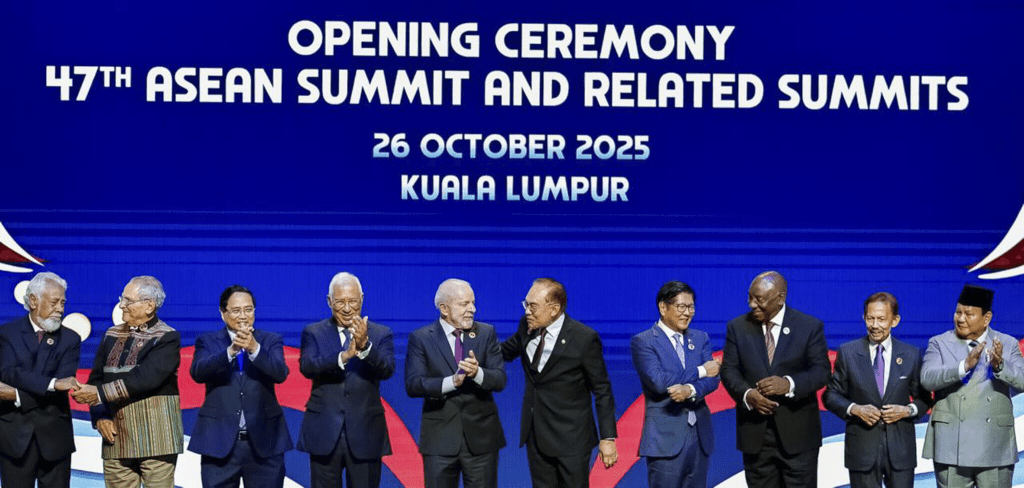
The 47th Summit of the Association of Southeast Asia Nations (ASEAN), held in Malaysia in October 2025, was a pivotal moment in the ongoing attempts by the United States to redefine the socioeconomic trajectory of Southeast Asia. While much analysis of the Summit has focused on the impact of US tariffs, there has been less attention to how these deals constrict the region’s monetary autonomy. Here we focus on the stipulations in the deals that will impose monetary subservience in Malaysia and Thailand, under the framework of ASEAN. The signing of these agreements is not a purely exogenously drive, but rather aligns with ASEAN’s historical anticommunist foundations. By deepening the region’s subordination to the United States while simultaneously expanding trade relations with China, the deals also hold implications for reconfiguring racial and class dynamics in the region.
On May 7th 2025, the Chilean government confirmed a report published earlier that morning: Chinese companies BYD and Yongqing Technology (Tsingshan Group) had abandoned their planned lithium cathode production facilities in Chile. This announcement dealt a significant blow to the ambitions of a country with a longstanding mining tradition, now striving to build industrial capabilities and develop value-added products from its mineral resources amid the global energy transition. However, just one day later, the Chinese embassy in Chile contradicted both the initial report and the Chilean government’s confirmation. After consultations with both companies, the embassy clarified that neither had officially withdrawn their investment plans. Instead, they reaffirmed ongoing interest in maintaining dialogue with Chilean authorities. The embassy further emphasized Chile’s continuing attractiveness to Chinese businesses, highlighting the numerous firms eager to participate in the country’s National Lithium Strategy. Despite Tsingshan’s formal withdrawal and BYD moving in the same direction, the Chinese embassy’s statement—issued amidst escalating trade tensions and shifts in the international order—suggests this chapter is far from concluded.
This episode highlights the complexity and uncertainty confronting peripheral economies attempting to industrialize by leveraging their comparative advantages amidst the so-called energy transition and broader geopolitical tensions marked by trade wars. While significant global attention remains focused on the socio-environmental impacts of critical mineral extraction, less consideration has been given to examining how peripheral economies—countries heavily reliant on natural resource extraction—are strategically navigating or capitalizing on this “critical minerals moment” in relation to their own ambitions to industrialize.
It has been more than a century since Ambedkar’s second disquisition in the discipline of economics was published; The problem of the rupee: its origin and its solution was published in the year 1923. Ambedkar was awarded a Doctor of Science (D. Sc) upon completion of the aforementioned dissertation from the London School of Economics. Later, during the same year, it was published as a book (Jadhav 2015, p. 39).
This essay is fundamentally a tribute to The problem of the rupee; it aims to serve as a primer by discussing the theoretical gravitas and intellectual depth that Ambedkar’s second disquisition entails. While it is well-recognized that Ambedkar was trained in economics—holding two doctoral degrees[1]—and made significant contributions to law and politics, this essay sheds light upon a few interactions with different economists and economic conditions that Ambedkar’sThe problem of the rupee engages with and subsequently invites for more extensive and nuanced engagement with the monograph.
Earlier, there have been multiple scholarly contributions that engaged with The problem of the rupee. However, they present only the overarching arguments i.e., the arguments are void of the details that explain the intellectual brilliance that is present in Ambedkar (1923). For instance, Jadhav claims that, after evaluating the Indian monetary system and operations, Ambedkar was in favour of a gold-standard rather than a gold-exchange standard (1991, p. 980). In a rudimentary sense, what gold standard and a gold-exchange standard mean is that the former indicates a monetary practice where gold is the direct form of currency that would be available for circulation. On the other hand, the latter i.e., the gold exchange standard is a condition where gold would not be a medium of exchange, but another form of currency would be the medium of exchange as gold would be held for reserve exchanges.
The economist Alice Amsden’s work unmasked the dirty secret underlying capitalist development: it relied on states breaking all the rules of the free market. But her work also showed that industrialization required corporate discipline, not welfare.
For American defenders of economic liberalism and free markets, China’s rise has been deeply disorientating. Unmoved by concerns about the market distorting effects of picking winners, the Communist Party of China has engaged in a focused campaign of industrial policy, using the state to discipline firms that have gone on to become globally competitive.
For the economist Alice Amsden, who came to prominence in the late 1980s for her writing on global development and died in 2012, the success of China would not have come as a surprise. Amsden began her career as powerful development institutions such as the World Bank were touting deregulation and privatization as solutions to global poverty. But the experience of the postwar years, in which South Korea — a recurring object of study for Amsden — used industrial policy to drag itself into middle income status, was a refutation of the orthodoxies rehearsed at Davos and in the International Monetary Fund.
The embrace of state subsidies to firms, tariffs, and large-scale infrastructure spending under Joe Biden and Donald Trump’s presidencies is partly a concession to the kind of developmentalist thinking advocated by Amsden. However, Amsden, a fellow traveler, if not devotee, to Marxism offered a more ambivalent assessment of the records of late industrializing nations like South Korea and China than defenders of Biden/Trumponomics are perhaps willing to countenance. For her, the repression of labor was as important to the success of these nations as large-scale economic coordination.
What if the story of economic development doesn’t begin with the market, but with the household? And what if property, often assumed to be a static bundle of rights, is better understood as a dynamic institution—adaptive, historically layered, and relational?
These questions sit at the heart of my recent research, which I had the opportunity to present at the Open University’s legal histories conference Land and Property Beyond the Centenary. While my work focuses on property governance and transformation in rural China, its implications stretch far beyond. It challenges dominant liberal narratives about property and development by presenting institutional change as a process of negotiated adaptation shaped by vulnerability and crisis, rather than a linear path towards free markets and individual ownership.
At its core, this work brings into dialogue three theoretical frameworks that are rarely combined: resilience theory, Martha Fineman’s vulnerability jurisprudence, and evolutionary institutional economics inspired by Thorstein Veblen. Together, they offer a rich toolkit for reimagining how development happens—and for whom.