What actually constitutes the key agenda for workers in Indonesia beyond celebrating May Day as a symbol of struggle? Wages in Indonesia are never truly “negotiated”; they are determined, stabilized, and at the same time separated from the political power that should be able to challenge them. Since the authoritarian New Order regime, the state has built a corporatist framework that not only suppresses independent worker organizations but also fragments the possibility of forming an effective collective force. Reformasi did open space for freedom of association, yet instead of producing consolidation, what emerged was fragmentation—many unions, but weak and divided. Thus, when integrated into global value chains, this configuration finds its function: the state no longer needs to repress workers overtly; it suffices to stabilize wages through mechanisms that appear technocratic, while allowing fragmentation to persist. In this way, low wages in Indonesia are not a failure, but rather the result of a strategy historically shaped and continuously reproduced—a form of partial class accommodation, uneven, and spatially conditioned.
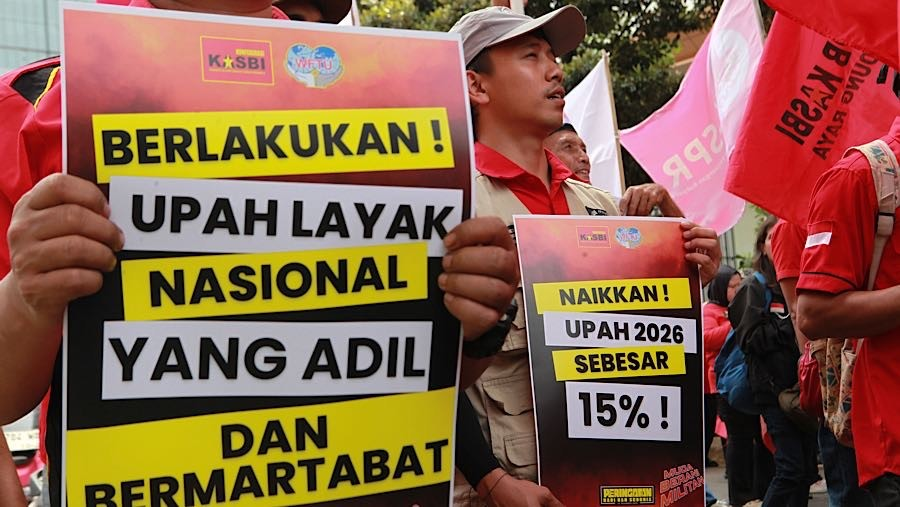
Control over workers today no longer operates primarily through open repression, but through the way wages are calculated and normalized as a technical matter. Wage-setting formulas that link minimum wage increases to inflation and economic growth are presented as rational policies to maintain balance between worker and business. Yet this is precisely where the politics operates: wage conflict is removed from the arena of collective bargaining and locked into calculations that from the outset limit bargaining space. This shift becomes clear when compared to the mechanism based on Decent Living Needs (KHL), which—although not entirely free from depoliticization—still opened space for surveys and the articulation of demands, particularly in industrial areas with high concentrations of workers. Because it was seen as disrupting worker cost stabilization, this space was later closed through formulas that standardize increases while simultaneously dampening conflict. Concessions to workers are not entirely eliminated, but emerge as the result of struggles that under certain conditions succeed in forcing the state and capital to grant space, as in the case of THR and the expansion of social security through BPJS. However, these achievements do not alter the fundamental structure of wages, which remains low and fragmented; rather, they appear as limited and segmented compromises. Thus, what is produced is not merely wage stabilization, but also the management of workers’ power itself: on the one hand, there are forms of protection that are concentrated and appear progressive, while on the other, the underlying structure continues to maintain spatial differentiation and the collective weakness of worker. In this condition, class compromise does not occur comprehensively, but is produced partially, unevenly, and remains locked within a low-wage regime.
Read More »
