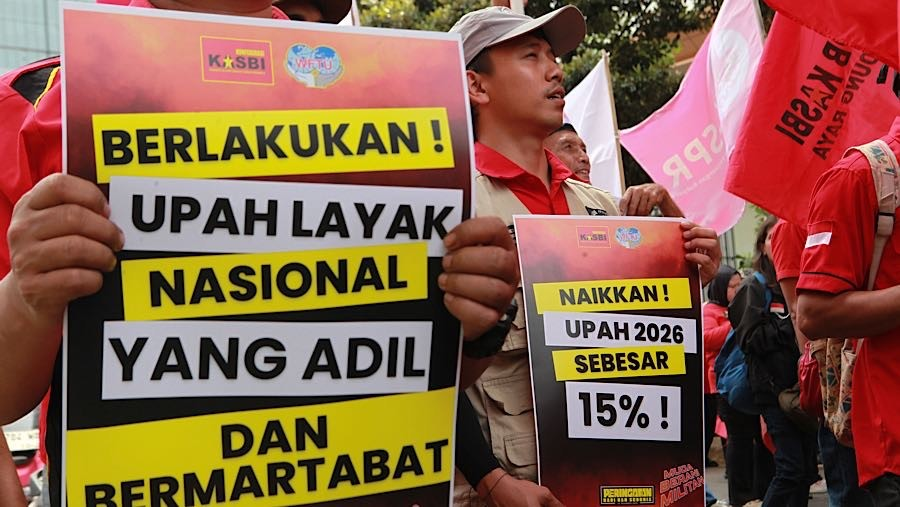
Stabilising wages, fragmenting workers: what comes after Indonesia’s wage ruling?

What actually constitutes the key agenda for workers in Indonesia beyond celebrating May Day as a symbol of struggle? Wages in Indonesia are never truly “negotiated”; they are determined, stabilized, and at the same time separated from the political power that should be able to challenge them. Since the authoritarian New Order regime, the state has built a corporatist framework that not only suppresses independent worker organizations but also fragments the possibility of forming an effective collective force. Reformasi did open space for freedom of association, yet instead of producing consolidation, what emerged was fragmentation—many unions, but weak and divided. Thus, when integrated into global value chains, this configuration finds its function: the state no longer needs to repress workers overtly; it suffices to stabilize wages through mechanisms that appear technocratic, while allowing fragmentation to persist. In this way, low wages in Indonesia are not a failure, but rather the result of a strategy historically shaped and continuously reproduced—a form of partial class accommodation, uneven, and spatially conditioned.

Control over workers today no longer operates primarily through open repression, but through the way wages are calculated and normalized as a technical matter. Wage-setting formulas that link minimum wage increases to inflation and economic growth are presented as rational policies to maintain balance between worker and business. Yet this is precisely where the politics operates: wage conflict is removed from the arena of collective bargaining and locked into calculations that from the outset limit bargaining space. This shift becomes clear when compared to the mechanism based on Decent Living Needs (KHL), which—although not entirely free from depoliticization—still opened space for surveys and the articulation of demands, particularly in industrial areas with high concentrations of workers. Because it was seen as disrupting worker cost stabilization, this space was later closed through formulas that standardize increases while simultaneously dampening conflict. Concessions to workers are not entirely eliminated, but emerge as the result of struggles that under certain conditions succeed in forcing the state and capital to grant space, as in the case of THR and the expansion of social security through BPJS. However, these achievements do not alter the fundamental structure of wages, which remains low and fragmented; rather, they appear as limited and segmented compromises. Thus, what is produced is not merely wage stabilization, but also the management of workers’ power itself: on the one hand, there are forms of protection that are concentrated and appear progressive, while on the other, the underlying structure continues to maintain spatial differentiation and the collective weakness of worker. In this condition, class compromise does not occur comprehensively, but is produced partially, unevenly, and remains locked within a low-wage regime.

Read More »

Green Debt Bondage: How Indonesia’s Electric Transition Deepens Platform Driver Exploitation

Somewhere in the state of Maharashtra, a cotton farmer took his own life after years of compounding debt and crop failure. Across India, this tragedy is not rare. The National Crime Records Bureau recorded 11,290 farmer and farm-labourer suicides in 2022—roughly one death every hour—with debt consistently identified as a leading cause (Down to Earth, 2023). In Sulawesi, Indonesia, villages are being cleared to make way for nickel smelters that supply the batteries of the global electric-vehicle boom. Workers at the Indonesia Morowali Industrial Park earn higher wages than they would in farming, but face fatal furnace explosions and respiratory damage as recurring occupational risks (Campbell & Lee, 2024; Global Witness, 2025). And on the streets of Jakarta, Yogyakarta, and Surabaya, a new population of electric motorcycle drivers pedal their way through twelve-, fourteen-, sixteen-hour days (Novianto, 2025a), servicing loans they never chose and rental fees that can never be fully paid.

These are not three unrelated stories. They are distinct moments in a single global process: the uneven, extractive, and deeply political reorganisation of labour under the banner of the green transition. In this article, I want to argue, drawing on my fieldwork with electric-vehicle (EV) platform drivers in Indonesia, that this reorganisation has produced what I call a regime of green debt bondage—a configuration in which ecological transition, platform governance, and financialised credit converge to bind workers to perpetual labour without delivering the promised climate dividend.

Debt bondage is most often associated with pre-capitalist or early-capitalist forms of coercion: the indentured plantation worker, the brick-kiln labourer, the trafficked domestic servant (Breman, 2007; Brass, 2011; LeBaron, 2014). Its reappearance inside the shiny, algorithmic, climate-friendly infrastructure of platform capitalism should unsettle us. It signals not a rupture from coercive labour regimes, but their transformation into more diffuse and systemically embedded forms. What I call green debt bondage refers to a condition in which workers are not only tied through credit, rental schemes, and platform deductions, but are also structurally compelled to remain within precarious work due to the absence of viable, decent employment alternatives.

In this regime, indebtedness does not operate in isolation; it interacts with broader labour market constraints that limit workers’ capacity to exit. Debt becomes a mechanism that deepens this entrapment—pushing drivers to work longer hours, accept worsening conditions, and absorb greater risks simply to service obligations they cannot easily escape. As such, the “greening” of transport in Southeast Asia does not merely reorganise infrastructure, but reconfigures coercion itself: embedding exploitation within both financial relations and structural labour precarity under the banner of ecological transition.

Read More »

The partnership trap in the Indonesian gig economy

In the last three months, there have been three strikes by gig workers in Indonesia. Problems related to harsh working conditions, injustice, and the decline in the welfare of gig workers became the main issues in the three strikes. The biggest strike was carried out by GoKilat couriers (delivery service from the Gojek platform company) for 3 days on 8-10 June 2021 involving nearly 1,500 couriers or almost 80% of active couriers on GoKilat. A day later, couriers from Lala Move went on strike spontaneously for three days by mass deactivating accounts on their platform application.

Prior to the two strikes above, on April 6, 2021, a strike was carried out by Shopee Express couriers for 1 day in Bandung, Indonesia, involving around 1,000 couriers. The Shopee Express courier strike was motivated by a cut in the payment they received. The new rules reduce courier revenue from 2,500 rupiah (US$0.17)/package to only 1,500 rupiah (US$0.10)/package and that is the only income earned by the couriers. In other words, they did not earn basic income equal to the minimum wage in the province where they work. Moreover, they did not have health insurance, decent working hours, overtime pay, leave /holiday rights, and severance pay. The working conditions were worse due to the fact that the vehicles (motorcycle) used are theirs and they had to pay fuel cost.

With such a wage system, to be able to earn the minimum wage in Bandung City in 2021 of 3,742,267 rupiah (US$263.16) per month for instance, couriers have to deliver 2,495 packages monthly—not including fuel and maintenance costs they have to pay. It means that they would have to deliver about 104 packages per day to the customers. If, on average, a package is delivered in 10 minutes, they need 17 hours per day, far above the decent 8 hours work day. This oppressive work system for gig workers is possible and there is no prohibition from the Indonesian government, due to the courier’s status as an independent contractor ormitra” (partner) for the platform company, instead of labor.

The precarious and uncertain working conditions stem from the misclassification of their employment status. Companies classifies them as “partners”, so that they could avoid the obligation to provide the minimum wage, health insurance, overtime pay, severance pay, 8 working hours per day, and holiday rights if they were labor, although the working relationships between the companies and their couriers represents the employer-employee relationships as there are shift work for the couriers, work control by the companies, requirements in recruitment such as contracts of employment, and the companies unilateral rules established by the companies.

Read More »

Return of the Bond Villains

In 1825 a Javanese prince named Diponegoro touched off a five-year, ultimately unsuccessful, war of resistance against the Dutch colonial government. As detailed by Peter Carey in his biography of Diponegoro, one of the causes was a land-rent system imposed by the Dutch on the Javanese sultanate of Yogyakarta. Under this system, landowners were encouraged to rent their estates directly to European plantation owners for the production of cash crops. This had a disruptive effect on the local economy and the Governor-General ordered it halted. But there was a catch. As the land-rent system was unwound, the Javanese landowners were forced to buy out the plantation owners in order to get control of their land back.

Many had already used the rents to buy imported luxury goods, and they fell into debt paying out large and often inflated sums to the plantation owners. The sultan was expected to back-stop these debts using payments he received from the Dutch for granting them the right to collect revenue on the kingdom’s toll roads. This created a situation where a Javanese merchant travelling from Yogyakarta to Semarang had to pay fees to the Dutch toll road agents. A portion of those fees then went to the sultan, who used them to back-stop debts being incurred by Javanese landowners as they bought back their own land back from European plantation owners.

Read More »