When we discuss the climate crisis in economics, we are often confronted with a debate resting on technical solutions, emissions paths, and energy use: a certain amount of time to go from coal to turbines means a certain amount of carbon dioxide emitted, which means a certain likely degree of global temperature change. In environmental economics, climate change and its associated environmental problems are often framed as ‘externalities’; that is, unfortunate and unintended spillovers caused by market mechanisms. Often, social issues are taken into account within this narrative through sunny phrases like “sustainable development” or “just transition.” The responsible parties are often individuals, states, or firms that are often thought to take action within the market. What does this debate look like if we take two different questions as starting points: not how to solve the climate crisis through market mechanisms and regulation, but how to solve the climate crisis while attending to the colonial legacy and exiting from contemporary neo-colonial accumulation patterns? Let us take a look.
Imperialism is still a relevant concept today, woven much more tightly into the structures of countries and economies than ever. The outcome of those seeking to expand their ownership or influence has stayed just as colonial and imperialist as ever before, especially now with the massive amount of capital accumulated in developed countries and the influence these countries have over the rest of the world. In a paper by John Foster, he quotes Harry Magdoff when he said, “Imperialism is the way of life of capitalism,” when asked if it was still necessary (Foster et al., 2019). To expand, capitalism needs a mode or justification or framework that it adopts and has a history of working so well with, and that is imperialism. Colonizing, occupying, and dominating are blatant ways that imperialism effectively occurs in history. It has not changed significantly except that the people furthering their “expansion” are not outrightly removing, killing, or taking resources from people; they now sign policies, laws, or rules, and then people follow this or follow it by force. Historically, the effects of imperialism have remained. We see this in the Native Americans who are forced to live on reservations whose way of life and traditions are limited due to state and private ownership of surrounding land in the form of preservations, parks, or plants for resourcing.
Imperialism can manifest in various forms: military, economic, cultural, agricultural, technological, and political influence. The United States, for example, has the largest military in the world, spending billions of dollars on funding its military and weaponry and maintaining this presence in countries worldwide. It has military bases all over the U.S. but also in Japan, Germany, and South Korea, amongst the most significant bases, and then in at least 80 countries such as Turkey, Bahrain, Spain, Honduras, and Cuba (O’Dell, 2023). This form of maintaining an imperialist presence is, in many ways, a reminder of the global hegemon that is the U.S. militarily and economically. The “silent” presence of the military that Prabhat Patnaik discusses in his paper “Whatever Happened to Imperialism” symbolizes the coercion of power the U.S. has over the rest of the world. A reminder that the United States could quickly get involved in smaller countries’ affairs (Patnaik, 1990). It is an effective tactic since massive amounts of weaponry can easily overpower another country or group of people.
Even more significantly, imperialism has manifested in global food systems. During the rise of the United States into its power today, there are clear examples of state-sponsored policies that changed the diets and modes of producing food. This mode of controlling and forcing people to consume food of the dominant hegemonic power has been seen throughout history, especially with indigenous peoples’ communities. An example of this state influence over food in indigenous communities is in what is now known as California; during the 1850s, with the invasion of European Americans, the people that lived in the Klamath Mountains, the Karuk People, were severely affected by the racial formations and domination for land and resources that the state was forcing upon them. The Karuk people lived near the Klamath River, and fishing was a primary form of survival in 1970. Although they had legal rights to fish in their river, state officials often arrested them for fishing, destroying their way of life and traditions. In this example, we see the state forcing people to assimilate. Since many of the Karuk people were trying not to be arrested or even killed, many of them resorted to eating government food, which lacked nutrients and was also forcing the native people to consume and engage in practices that were “White” behaviors via boarding schools and other consumption behaviors that were not a part of their culture (Norgaard, 2011). Also, arresting the indigenous people is trying to erase the existence of these people in the first place, which is genocide continuing. This example of the Karuk people demonstrates how taking over land, either physically or legally(coercively), is perhaps a dominant way to maintain and gain control of people. The ability to own land or own the means of how food is produced is vital in being able to live healthily and sustainably. Also, food in almost any culture has significant meaning and symbolizes traditions passed down. Removing traditional food and practices removes culture and identity. If imperialism is how a state or group of people exercises control to maintain power via economic and social relations, then the first and most dominant way is to remove the ability to access resources for food. This is followed by the stripping away of culture and traditions. This happened with the Native Americans and still occurs in the global south and north today, although how those limitations exist in each may vary.
The spread of corporate power and how quickly it has dominated food and other consumed agricultural resources is also relevant to how it impacts development. Using the United States as the example in this analysis, how it produces its food and is influenced by corporate power in agricultural industries affects other developing countries where many of the subsidized crops grown here are exported. Philip McMichael highlights the corporate food regime in their analysis of food regimes and their history in the Handbook of Critical Agrarian Studies by Akram-Lodhi. McMichael denotes that a corporate food regime has risen in this neoliberal era of corporate power. A food regime plagued with exporting grains and crops to developing countries while continuing its high grain growth here in the U.S. The Farm Bill heavily subsidizes corn, wheat, soy, and rice and directly fuels this. He writes
In the 1990s, trade agreements (notably the WTO and associated free trade agreements) instituted liberalization measures to universalize ‘market rule’ via neoliberal agricultural investment and trade freedoms for transnational agribusiness. US and European Union subsidies for agribusiness artificially cheapened foodstuffs for dumping in world markets at the expense of now unprotected Southern farmers’ (Lodhi et al., 2021).
This advanced the dominance of the United States imperial programming and subjugated developing countries into cycles of foreign debt and political unrest. Artificially deflating the price of crops, countries struggled to develop large agricultural industries and could not develop economically past the agricultural stage. The United States used this domination to convince developing countries that they could develop manufacturing and resource extraction-based industries by increasing their reliance on foreign aid and foreign investment. However, they were subordinated into global structures of domination and colonization that few countries have been able to escape. In this conceptualization of corporate food regimes, McMichael denotes how the corporate influence of power affects not only U.S. consumers but also the livelihoods of small agricultural producers, domestically and internationally. Having power over food and agriculture is a prevalent form of imperialism and capitalism, and this severely impacts the course of development. If the most basic form of sustainment is unavailable, then, from a nutrition standpoint, how can people function and live properly? Malnutrition from starvation or nutrient deficiencies severely impacts survival or health outcomes.
An example of food imperialism can be seen in Palestine, which, under its occupation, cannot control its access to land and water resources. This has led, over the decades, and more prominently now in the current crisis, to severe food insecurity and malnutrition. In the West Bank, 63% of the cultivable land is under Israeli government control, and they only have about 15% access to groundwater from the Western Aquifer Basin. In contrast, the Israeli government controls and uses the rest (~85%). Controlling land and limiting what food can be grown and imported have impacted the course of development for these people (Shaban, 2022). In the relevance and different forms that imperialism has, this is a current example of the historically brutal forms in which power is exercised over people through agriculture and food.
Seeing corporate power reflected here in the United States, we can turn to the poultry industry and labor practices that occur here in the efforts to produce massive quantities of meat and profit. In 2019, the U.S. poultry industry produced 42 billion pounds of chicken, more than any other country globally, enough to give every person on Earth about 5.32 pounds of chicken (Freshour et al. 2020). Most of the workers in the processing plants are Black, and many are ex-felons since this is one of the few industries that will hire them. Many workers are subjected to long hours of standing and monotonous work on a processing line that will often speed up, and workers must work faster to process the meat. Not only creating health issues such as arthritis but also the time taken away from these workers to rest.
Agriculture and food are areas of extreme relevance to the concept of imperialism. Manifesting through corporate power, the economic and social relations that spread hegemonic domination over agriculture and food is one of the fastest ways to extend a state’s or group’s influence over countries and people. What people need to survive more than anything is food and water. To have influence or control over how it is produced and distributed, as well as who produces and distributes it, is a clear demonstration of the relevance of the concept of imperialism. This is why steps taken to remove much of the corporate power held in the global agricultural industry are essential in creating a more just and sustainable future.
References
Akram-Lodhi, A. H., Dietz, Kristina, and Engels, Bettina, eds. 2021. Handbook of Critical Agrarian Studies. Chapter 25. Food Regimes Philip McMichael, Cheltenham: Edward Elgar Publishing Limited. Accessed December 15, 2023. ProQuest Ebook Central.
Foster, John B., Utsa Patnaik, Prabhat Patnaik, Samir Amin, Intan Suwandi, Hannah Holleman, Brett Clark, Ricardo Antunes, Harry Magdoff, and Firoze Manji. 2019. “Late Imperialism.” Monthly Review.
Freshour, Carrie, Nick Estes, Roxanne Dunbar, Charisse Burden, Bill Fletcher, Lilia D. Monzó, Jesse Benjamin, et al. 2020. “Poultry and Prisons.” Monthly Review.
Norgaard, K. M., Reed, R., & Van Horn, C. (2011). A continuing legacy: Institutional racism, Hunger and nutritional justice on the Klamath. in Alkon, A. H., & Agyeman, J. (Eds.). (2011). Cultivating Food Justice: Race: Class, and Sustainability. MIT Press.
Mirette Nunez is a master’s student in Economics at The New School. Her research interests are in the effects of corporate power and capitalism on global food and agriculture systems.
Feeling helpless does not mean being useless. It is possible to support Palestinians from afar.
College instructors, particularly those in Europe and North America, are generally limited when it comes to meaningful intervention in imperialist horrors afflicting the Global South. Nevertheless, it is usually their governments either orchestrating or abetting the horror. They ought to do something, then, even if it seems pyrrhic or inadequate.
People around the world are now witnessing a particularly gruesome event as the Zionist entity, armed by its U.S. sponsor and enjoying the support of capitalist institutions across the globe, commits one atrocity after the other in the Gaza Strip (along with the West Bank and at times further afield). The atrocities, anyone with a modicum of integrity agrees, add up to genocide. The depth of grief and suffering Palestinians now experience is indescribable, immeasurable.
Do professors and other campus workers have any ability to mitigate the grief and suffering? Not really. But we’re not entirely powerless, either. Higher education is an important sector for information and activism and an industry where participants like to contemplate the role of both exceptional and ordinary people in making a better world. Like anybody else, teachers and researchers can be most effective in their own communities, which are not inoculated from the genocide. Zionist groups have organized hundreds of defamation campaigns against Palestinian students and faculty, often resulting in employment termination and other serious forms of recrimination. These campaigns don’t exist in a vacuum. Targeting Palestinians and anti-Zionists is an extension of the genocide, or at least one of its attendant tactics. And then, of course, many of the campuses are somehow invested in the Zionist entity—financially, politically, or logistically. It does no good to say that “we” aren’t affected by what happens “there.”
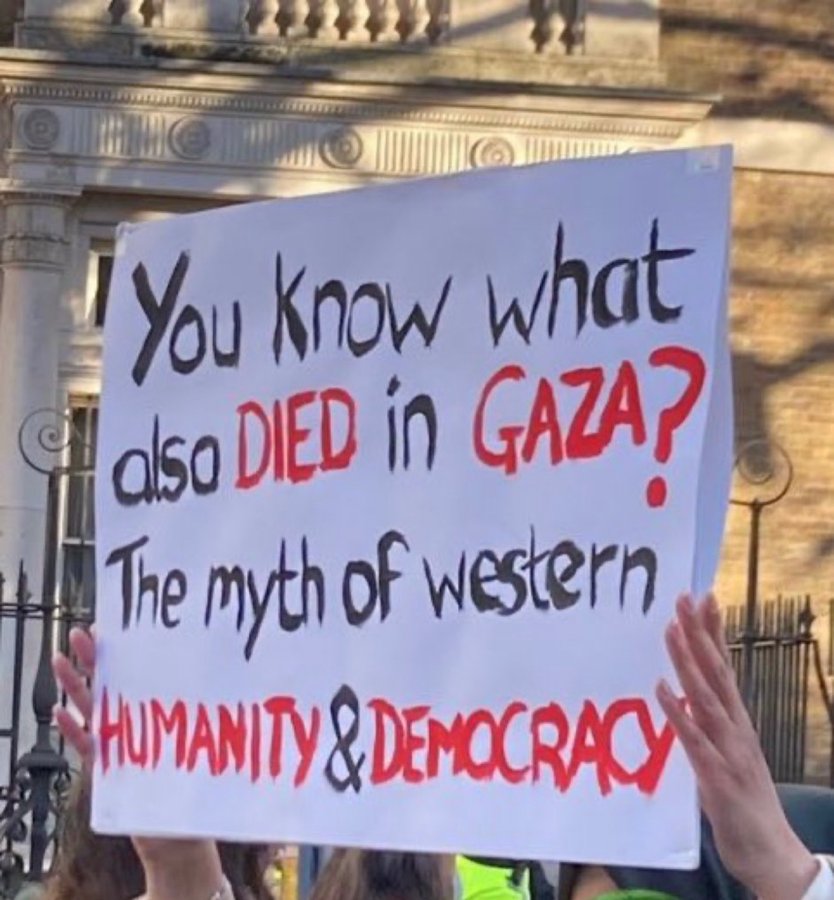
The on-going ethnic cleansing and genocide of Palestinians in 2023, marks the end of the façade of the peaceful Western liberal order. At least 940,000 people have been killed by direct war violence in Iraq, Afghanistan, Syria, Yemen, and Pakistan. While these countries were subject to the different ebbs and flows of US imperial violence. Palestinians have paid the heaviest price. The historical occupation of Palestine has always been a socio-economic precondition for the cohesion of the G-7 but the current ethnic cleansing can no longer be contained through the usual narrative control tools and an ever intensifying climate of fear promulgated to the ends of silencing and chilling legitimate support for Palestine internationally. As Steven Salaita notes, the genocide has shown us that ‘Impunity isn’t beholden to disapproval’, and we continue to bear witness to the genocide for ourselves and for the next generation. The current genocide is the clearest expression of the decrepitude of the Western order in a state of ongoing entropy. What follows shall be bereaved of the usual pretences of ‘democracy’ and ‘human rights’ and thus more naked, brutal and yet more reactionary. The Western order is generating the conditions for its demise. In this, Palestine leads the way. Palestine changes everything.
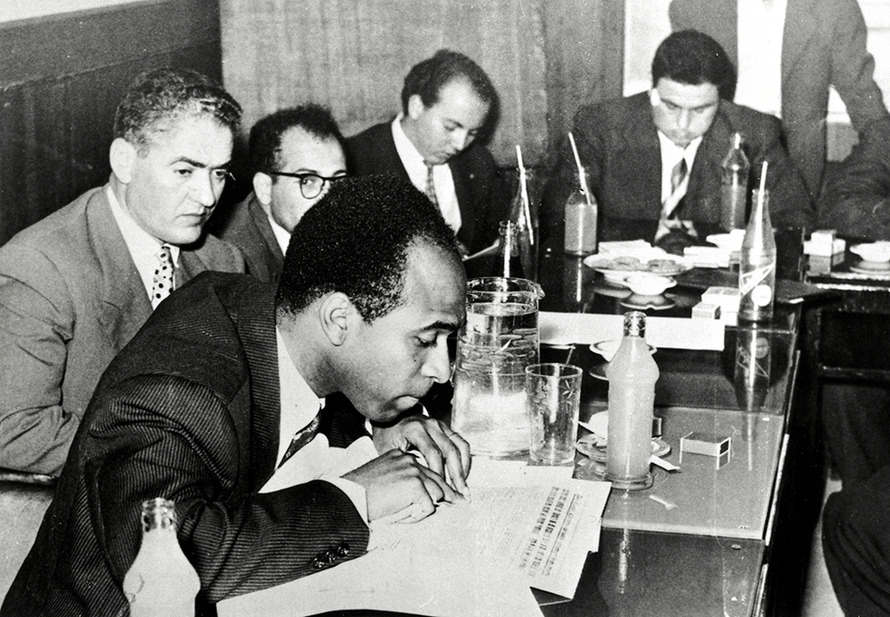
The great cultural theorist Stuart Hall called Frantz Fanon’s The Wretched of the Earth ‘the bible of decolonisation’ as it encapsulated the urge for freedom across the colonial world (1). Fanon illuminates how racism represented an organising principle for capitalist classes by systematically devaluing the lives of the majority of the world’s population. ‘For centuries the capitalists have behaved like real war criminals in the underdeveloped world,’ he wrote. ‘Deportation, massacres, forced labour, and slavery were the primary methods used by capitalism to increase its gold and diamond reserves, and establish its wealth and power’ (2).
One of the reasons for Fanon’s popularity among those who want to decolonise development is that he argued that post-colonial countries should forge their own paths to development rather than attempting to follow already developed countries. ‘The Third World must not be content to define itself in relation to values which preceded it,’ he warned. ’On the contrary, the underdeveloped countries must endeavour to focus on their very own values as well as methods and style specific to them.’
Not only did Fanon explain the horrors inflicted by colonialism upon native populations; crucially, he also conceived of real human development as a process rooted in a collective labouring class (comprising workers and poor peasants) transcending capitalist brutality.
However these two elements of his thought — the critical identification of the violence of colonialism, and a real human developmental alternative to it — have often been disconnected by thinkers influential to the decolonial movement. This represents a dangerous misinterpretation of Fanon. It obscures his vision of a decolonised world and the social forces able to construct it.
A new calendar year ushers in the usual array of tropes on Africa. They include why the continent is failing, what it should be doing better and why it has so much resilience in dealing with its own frailty. Overwhelmingly, Western institutions (NGOs, credit rating agencies, etc.) repeat tired mantras of the international financial institutions, ignoring the insights of African scholar activists and the historical backdrop to the continent’s contemporary crises. Neglect of such analysis leads to the failure to understand why and how different African countries are in the mess that they are and why the mess has structural continuities and conjunctural discontinuities. The antidote to Western-centric analysis is the superb collection of essays in a special issue of Africa Development, a journal of the Council for the Development of Social Science Research in Africa (CODESRIA), which emerged from the Post-Colonialisms Today project. The range and insight of the collection is difficult to capture in a short review, but there are two continuous themes among contributors: the importance of revisiting the historical past and the significance of sovereignty, or the absence of it.
In Everyday Politics in the Libyan Arab Jamahiriya, Matteo Capasso provides an alternative analysis of Libya’s history and regime under Colonel Gaddafi leading up to the 2011 events that sanctioned its fall. The book offers a compelling counterargument to the mainstream narrative of Libya as a stateless, authoritarian and rogue state by focusing on international and geopolitical dynamics impacting Libya’s governance.
Q.1 Your book argues against the dominant western analysis of Libya under Colonel Gaddafi as a dictatorship, completely dependent on its economic legitimacy from oil. To quote:
‘This book has cautioned readers from rushing to define the Jamahiriya as an umpteenth authoritarian regime in the Arab world that crushes and controls its people. The significance of this issue lies in how the increasing repressible characteristic of the regime inevitably reflected wider power’.
What do you mean by wider power dynamics?
When you pick any book on the political history of Libya, you are bound to encounter the argument that Qaddafi’s Libya (not the Libyan Arab Jamahiriya or the Libyan government) was a stateless society, governed ruthlessly by a dictator who was aiming to disrupt the US-led international order. In the book, I define these arguments as a conceptual tryptic, including the ideas of statelessness, authoritarianism and rogue state. The book starts off questioning the use of these analytical frameworks and instead proposes to address questions of political legitimacy and authority via the study of the everyday. To do so, however, brought me to face another problem, namely the fact that most academic studies approach the ‘everyday’ with an overemphasis on the agency and power of the people. This, in turn, has led to dismiss a bit too quickly the impact of global and structural factors; and this is where I come to answer your question. While the everyday gained prominence and became a privileged site for studying politics in the Arab region, especially in the aftermath of the 2011 mass uprisings, these analyses remain disconnected from long-standing international dynamics of politics and political economy. In other worlds, how were these states integrated in the wider international political economy? Did the political projects pursued by the Libyan government, especially in the aftermath of the 1969 revolution, challenge the interests of Western geopolitical forces? Why was Libya progressively subject to military assaults and geopolitical pressure? If one ignores—rather conveniently—these aspects, it ends up to square one, basically explaining the politics of the country as the result of internal factors. In this manner, one not only delinks the socio-political formation of countries in the Global South from the international world, but also ends up flattening out its hierarchies existing.
A major theme that dominates the literature on development economics is the narrative of ‘Structural Transformation’, which, based on the experience of developed economies, envisages a gradual ‘modernisation’ of the economy. This process is expected to unfold in a similar way across the economies of global South, where the importance of non-agriculture/high-productivity/capitalist sectors in terms of both contribution to national income and labour employment would increase and that of agriculture/low-productivity/pre-capitalist sectors would fall, ultimately leading to dissolution of this dualist structure of the economy (Lewis, 1954; Kaldor, 1967; Kuznets, 1968). This transformation is expected to bring productivity gains across all sectors, reduce poverty, and lead to high levels of economic prosperity. According to Monga and Yifu Lin (2019), structural transformation is “arguably the single most significant concept and social goal in the global quest for prosperity and world peace.”
However, many of the economies of the global South have not been able to undergo this expected path of structural transformation. For example, in 2019, for sub-Saharan Africa, the average contribution of agriculture to GDP has been around 14% while the proportion of population employed in agriculture is 53%. The GDP contribution and employment figures range from 8% and 27% for East Asian and Pacific economies to 17% and 42% for South Asia respectively (World Development Indicators, 2021).
The dominant narrative, largely propagated by international agencies like the World Bank, still advocates the validity of the process of structural transformation, continues to use this framework to understand the labour and employment transition in the global South, and advocates policies to achieve the same. In contrast, within various critical strands of literature, there is an increasing realization that the nature and pattern of structural transformation that unfolded in the global North might not be replicable in the global South (Dorin, 2017; Scherrer, 2018; Breman, 2019). Building on some of these criticisms, we argue that the possibilities of attainment of a North-style structural transformation remains bleak in the contemporary global South. This is majorly because the socio-economic and political context which facilitated the process of structural transformation of the economies in the global North is no longer available to the global South. The process in the North was, to a large extent, fostered by colonialism which allowed these economies to undertake expropriation and extraction of resources, without much concern for ecological limits, as well as to transfer a proportion of their population to the newly found lands in the temperate regions. Given the significant changes in the structure of capitalism now as compared to the earlier phase, it is worthwhile to investigate the possibilities of the global South experiencing the envisaged path of structural transformation.
In the following sections, we elaborate on why the received wisdom in development economics no longer provides an adequate framework to understand capitalist development in the global South.




 Developing Economics