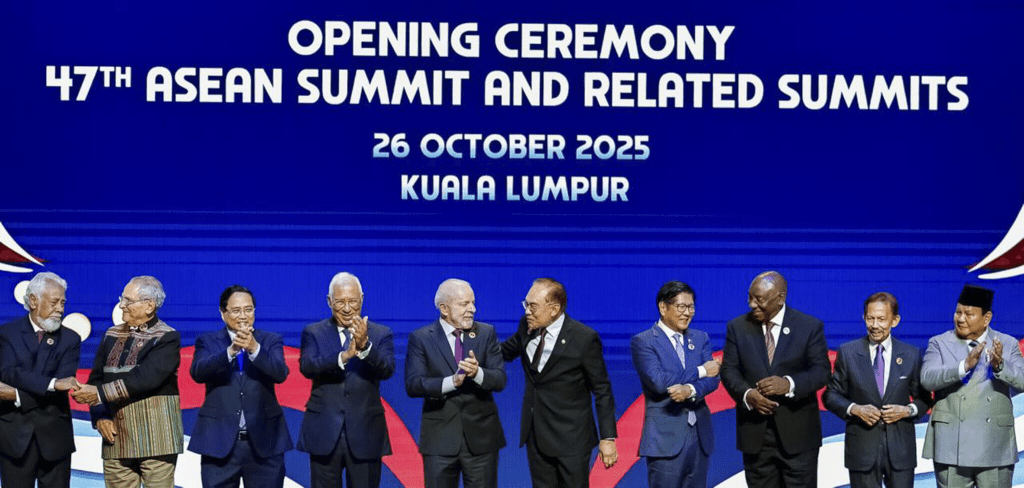
The 47th Summit of the Association of Southeast Asia Nations (ASEAN), held in Malaysia in October 2025, was a pivotal moment in the ongoing attempts by the United States to redefine the socioeconomic trajectory of Southeast Asia. While much analysis of the Summit has focused on the impact of US tariffs, there has been less attention to how these deals constrict the region’s monetary autonomy. Here we focus on the stipulations in the deals that will impose monetary subservience in Malaysia and Thailand, under the framework of ASEAN. The signing of these agreements is not a purely exogenously drive, but rather aligns with ASEAN’s historical anticommunist foundations. By deepening the region’s subordination to the United States while simultaneously expanding trade relations with China, the deals also hold implications for reconfiguring racial and class dynamics in the region.
“The purpose of studying economics is not to acquire a set of ready-made answers to economic questions, but to learn how to avoid being deceived by economists.” ― Joan Robinson
Recent years have seen a proliferation of debates on the shrinking of fiscal space in both industrialized and developing countries. In the former, the discussion often takes the form of agonizing over fiscal ‘black holes’, whereas in the latter it is usually presented in the context of ‘unaffordable debt’.
In reality, the real black holes, or blind spots, are those found in neoclassical economic models underlying such debates, rather than in the real economy (Table 1). We describe three such neoclassical fiscal black holes, based on our recent paper ‘The General Relativity of Fiscal Space’.
Table 1. Overview of fiscal black holes in the neoclassical paradigm.
Source: Authors’ elaboration. Shaded in black are the black holes of the neoclassical fiscal paradigm.
We show how fiscal space is not the absolute sum of taxes and borrowing, but rather relative in several ways. It depends on macroeconomic conditions, such as unemployment and inflation, countries’ degree of monetary sovereignty, and their level of productive capacity. Furthermore, fiscal space is relative to what governments do with it, expanding or contracting depending on the function of public spending.
It has been more than a century since Ambedkar’s second disquisition in the discipline of economics was published; The problem of the rupee: its origin and its solution was published in the year 1923. Ambedkar was awarded a Doctor of Science (D. Sc) upon completion of the aforementioned dissertation from the London School of Economics. Later, during the same year, it was published as a book (Jadhav 2015, p. 39).
This essay is fundamentally a tribute to The problem of the rupee; it aims to serve as a primer by discussing the theoretical gravitas and intellectual depth that Ambedkar’s second disquisition entails. While it is well-recognized that Ambedkar was trained in economics—holding two doctoral degrees[1]—and made significant contributions to law and politics, this essay sheds light upon a few interactions with different economists and economic conditions that Ambedkar’sThe problem of the rupee engages with and subsequently invites for more extensive and nuanced engagement with the monograph.
Earlier, there have been multiple scholarly contributions that engaged with The problem of the rupee. However, they present only the overarching arguments i.e., the arguments are void of the details that explain the intellectual brilliance that is present in Ambedkar (1923). For instance, Jadhav claims that, after evaluating the Indian monetary system and operations, Ambedkar was in favour of a gold-standard rather than a gold-exchange standard (1991, p. 980). In a rudimentary sense, what gold standard and a gold-exchange standard mean is that the former indicates a monetary practice where gold is the direct form of currency that would be available for circulation. On the other hand, the latter i.e., the gold exchange standard is a condition where gold would not be a medium of exchange, but another form of currency would be the medium of exchange as gold would be held for reserve exchanges.
In a 2022 report, International Monetary Fund (IMF) states that ‘[t]he dollar’s share of global foreign-exchange reserves fell below 59 percent in the final quarter of last year, extending a two-decade decline’. However, surprisingly, the decline in the dollar is not associated with the ‘increase in the shares of the pound sterling, yen, euro, and other long-standing reserve currencies.’ Instead, the shift in the dollar’s share in the reserve currency system went in two directions—a quarter into the Chinese renminbi and three-quarters into the currencies of smaller countries that have historically played a limited role as reserve currencies. This piece examines the shifts underlying this trend with a focus on increased regional alliances in trade and payment systems technology. We conclude with forecasts and implications for a more multipolar monetary order and ‘dollar diplomacy.’
Since the onset of the Covid-19 pandemic, geopolitical tensions and economic stagnation have led to fragmentation in cross-border trade and payment systems. The ongoing Ukraine-Russia conflict and international sanctions imposed by the Western economies have also contributed to this situation by causing disruptions for countries with trade relationships with Russia, particularly for essential commodities like fuel, grain, and oilseed. Moreover, many countries are running low on U.S. dollar reserves amidst inflation, prompting them to consider alternative currencies for cross-border trade settlements. This is further exacerbated by the aggressive rate hikes by the Federal Reserve in an attempt to contain domestic inflation within the U.S. The historical correlation between the U.S. dollar and commodity prices has been disrupted for the first time. As a result, evidence suggests a degree of regional fragmentation in trade-related activities and the use of alternative currencies, leading to a shift away from the U.S. dollar as the primary currency for international trade. For instance, in March 2023, the yuan was the most widely used global currency, surpassing the U.S. dollar and euro.
Further, central banks from emerging markets and developing economies seek to diversify their foreign currency reserve composition. The shift began in April 2022, after key Russian banks were removed from SWIFT following Russia’s invasion of Ukraine. China increasingly uses the yuan to buy Russian commodities, such as oil, coal, and metals, settling their bilateral trade with Russia in Chinese currency instead of dollars. In a similar effort, India has made several initiatives to create bilateral trade relationships with countries like Bangladesh, the United Arab Emirates, and Malaysia to internationalize the rupee and use it to settle cross-border trades. This trend toward exploring alternative currencies may affect the global financial landscape. Still, its impact is uncertain due to concerns about newer currencies’ volatility and regulatory systems.
The IFS research agenda recognizes that a “subordinate” national currency comes with a risk premium increasing the costs of financing public debt – in other words, the current, US dollar-based currency hierarchy acts as a structural fiscal constraint in the Global South, limiting the scope for badly needed public investments. Foreign capital – in the form of foreign currency-denominated sovereign and private debt-, foreign aid, and foreign direct investment – is then touted as a solution to this artificial and unfair developmental constraint.
The SF agenda examines how this straightjacket on fiscal space has been further compounded with the liberalization of global capital mobility over the past forty years, diffusing credit-based accumulation strategies from the Core to the Peripheries: the financialization of (semi-)peripheral economies radically misallocates financial resources from socially and environmentally vital public goods and transformative industrial policies towards developmentally regressive strategies of accumulation driven by speculation and asset-price inflation.
Programmatic visions for liberating (semi-) peripheral economies from the dual constraints of a national fiscal space suffocated by the global currency hierarchy and globally mobile capital flows which deepen financialization are underdeveloped. Two scales of action are plausible: At the international level, de-dollarization is promoted by the BRICS bloc, but it remains uncertain what forms of international financial solidarity and collaboration, if any, will materialize under its aegis. The national level comprises an alternative scale as the State continues to be perceived as the most likely candidate for ringfencing domestic social, environmental, and developmental objectives from the pressures of global capital mobility and the structural constraints of the global currency hierarchy.
In a recent co-authored piece with Pınar E. Dönmez, we study the politics governing the management of money in Hungary and Turkey, two semi-peripheral economies where the executive has built a vast array of direct and indirect tools to intervene in monetary policy, retail banking and credit allocation to manage financial subordination.
The surge of right-wing populism in East-Central Europe is often portrayed as an unforeseen shift from the earlier post-1989 liberalization path. The “illiberal transformation” narrative underlines stark differences between the policy arsenals that informed democratization and marketization reforms in the early 1990s and those fueling current “democratic backsliding.” Yet this framing conceals the analytical maneuver of disconnecting the political sphere from its socioeconomic counterpart, thereby limiting democracy to the former and defining democratic participation based on electoral competition.
It was precisely this separation, which at the dawn of post-communist transformation, tended to align democratization not with leveling erstwhile power and wealth disparities, but with eradicating rent-seeking by the lingering elements of Soviet bureaucracy. Conceived in this way, democratization was deemed to be an engine of market reforms. Insofar as much of the “transitology” scholarship operated with a parochial “democracy” versus “authoritarianism” dichotomy, it repeatedly obscured authoritarian tendencies in consolidating democratic systems.
In the recently published article Democratic Facades, Authoritarian Penchants: Post-Communist Monetary Restructuring in the Baltic States, I argue that the corpus on “authoritarian neoliberalism” is well-positioned to instigate a much-needed departure from this externalization of “political” and “socioeconomic” spheres when revisiting the intricacies of post-communist transformation in general and monetary reforms in the Baltic states in particular.
In collaboration with EADI and King’s College, London, Developing Economics has launched Season of the Hierarchies of Development podcast.The podcast offers long format interviews focusing on enduring global inequalities. Conversations focus on contemporary research projects by critical scholars and help us understand how and why structural hierarchies persist. Join hosts Ingrid Kvangraven (KCL/DE) and Basile Boulay (EADI) for this series of discussions on pressing issues in the social sciences.
The podcast was developed with editing support from Jonas Bauhof. Listen to old episodes and subscribe to get updates on new episodes here (you can choose your preferred platform).
In the first episode is on monetary hierarchies we speak to Karina Patricio Ferreira Lima (University of Leeds, UK) about hierarchies in money and finance, core-periphery dynamics of inflation, the role of the International Monetary Fund in assessing debt sustainability, and much more. Listen on Spotify with the link below.
“One of the chief contributions to peace that the Bretton Woods program offers is that it will free the small and even the middle-sized nations from the danger of economic aggression by more powerful neighbours. The lesser nation will no longer be obliged to look to a single powerful country for monetary support or capital for development, and have to make dangerous political and economic concessions in the process. Political independence in the past has often proved to be sham when economic independence did not go with it.” —Henry Morgenthou Jr (1945)
The world economy has a Dollar problem. Reliance on the currency of a single country as the world’s chief way to organise trade, carry out financial settlements, and store value creates a series of inequitable economic imbalances and policy tensions—both within the US and across the global economy. It bestows disproportionate economic and political power on the US government and financial institutions; exposes world trade and finance to instability and disruptions originating in the Dollar zone; imposes huge costs on the world’s small and even middle-sized nations; and fuels disproportionate growth in the US financial sector, bolstering its influence in that country’s political economy.
A Historical Problem
This problem is not new. In fact, the inability to develop an equitable and genuinely multilateral international monetary system is one of capitalism’s most striking institutional failures, going back to the early days of the industrial revolution. The gold standard of that time and its successors have always privileged some economies at the expense of others, and created policy biases favouring the interests of creditors and capital, at the expense of debtors and wage earners.
Only once in the history of capitalism did policy-makers from leading capitalist powers even consider the possibility of building a genuinely multilateral, equitable system: during the 1943-44 debates on the post-World-War-II economic order. But despite the aspirations and statements of participants like John M Keynes and then-US Treasury Secretary Henry Morgenthou Jr, the Bretton Woods conference led to the creation of a system centred on the US Dollar, under which foreign central banks could present dollars to the Federal Reserve for exchange into gold.
That system effectively charged US authorities with the supply of the world’s ultimate international reserves. In this task they were constrained only by the willingness of central banks in other states to hold Dollars instead of gold. As French Finance Minister Giscard d’Estaing put it in the 1960s, this arrangement defined an exorbitant privilege for the US economy, which enjoyed a lot of space for effectively issuing Dollars to acquire goods and assets overseas.
By the late 1960s, it became clear that the US economy could no longer uphold its obligations under the Bretton Woods system. Its steady loss of competitiveness in international trade, fiscal pressures from its protracted, losing war in Vietnam, and increases in social spending in response to domestic political turmoil, led to growing trade deficits, mass outflows of Dollars, and concerns that US authorities would not be able to meet foreign demand for convertibility of greenbacks into gold. In response, the US unilaterally abandoned its commitment to convertibility in 1971.
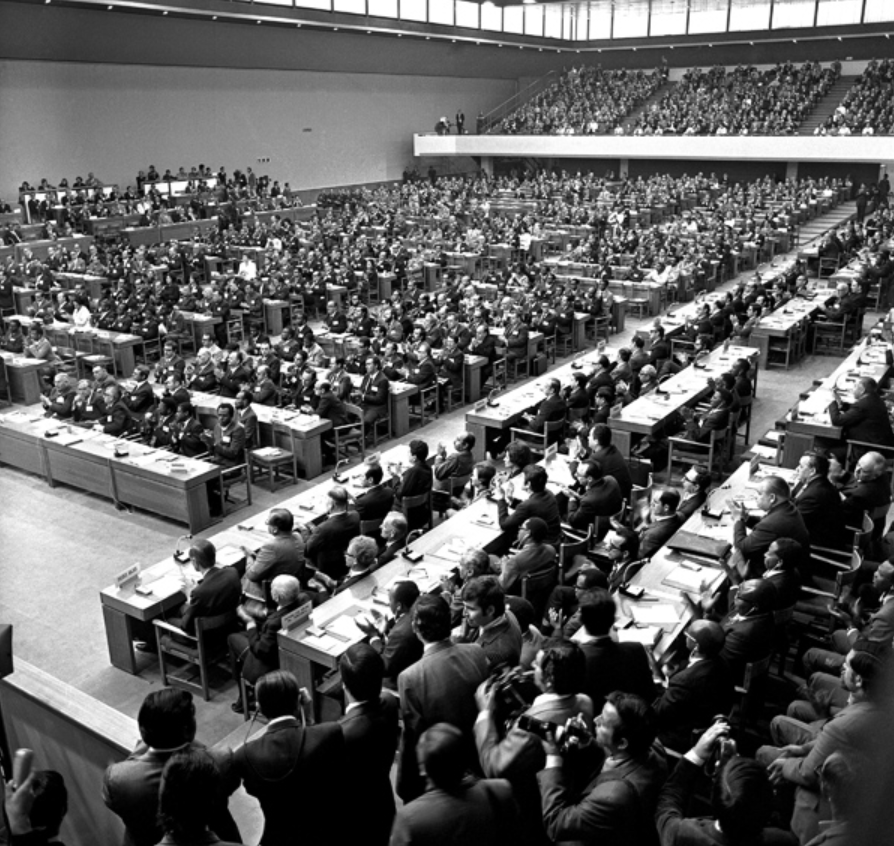
Coming amidst a series of successful national liberation and anti-colonial struggles across the world, the US’s inability to sustain the Bretton Woods system fed hopes that a new, equitable international monetary order could be constructed. The 1974 call by the United Nations for a New International Economic Order explicitly pointed to the need for a new monetary system centered on the “promotion of the development of the developing countries and the adequate flow of real resources to them” as means to dismantle “the remaining vestiges of colonial domination” and removing the obstacles in the way of international convergence in measures of economic development and living standards.





 Developing Economics