World Development under Monopoly Capitalism

Photo: do bicycles come from? Source: WDR2020, Figure 1.1, pp. 16.

One of the main effects (I will not say purposes) of orthodox traditional economics was…a plan for explaining to the privileged class that their position was morally right and was necessary for the welfare of society.

—Joan Robinson1

The recent period of globalization—following the collapse of the Eastern bloc and the reintegration of China into the world economy—is one where global value chains have become the dominant organizational form of capitalism. From low to high tech, basic consumer goods to heavy capital equipment, food to services, goods are now produced across many countries, integrated through global value chains. According to the International Labour Organization, between 1995 and 2013 the number of people employed in global value chains rose from 296 to 453 million, amounting to one in five jobs in the global economy.2 We are living in a global value chain world.3

The big question is whether this global value chain world is contributing to, or detracting from, real human development. Is it establishing a more equal, less exploitative, less poverty-ridden world? Which political economic frameworks are best placed to illuminate and explain the workings of this world?

Recent critical scholarship has applied monopoly capital concepts and categories to the analysis of global value chains. John Bellamy Foster and others have illuminated how global value chains represent the latest form of monopoly capital on a world scale.4 John Smith shows how surplus-value transfer and capture—from workers in poorer countries to lead firms in northern countries—is portrayed by mainstream economists as “value added” by those firms.5 Intan Suwandi analyzes how global value chains are enabled by, and also intensify, differential rates of worldwide labor exploitation.6

Mainstream advocates of global value chain-based development tend to ignore such critical analyses, and continue to preach the benefits of global value chain integration by drawing on examples and data that support their claims. However, it says much about the anti-developmental dynamics generated by global value chains when a World Bank report advocating global value chain-based development actually provides data that supports the analyses of the aforementioned critical authors.

Here, we interrogate the data used and the claims made in the World Bank’s World Development Report 2020, titled Trading for Development in the Age of Global Value Chains (WDR2020, or “the report”).7 While the report portrays global value chains as contributing to poor countries’ development through job creation, poverty alleviation, and economic growth, we reveal how its data shows the opposite.8

Read More »

Inner-city pressure and living somewhere in-between 

On a cold winter’s day in 2014, I sat awkwardly in the office of the person managing a high-rise apartment building in Johannesburg’s Central Business District (CBD). The building is a former office block that has been renovated by the city’s largest private affordable housing company and is currently rented as residential accommodation. Affordable housing is commercial rental housing that caters to people who earn too much to qualify for state-subsidised housing, otherwise known as social housing, but too little to purchase their own properties on the regular market. Rents in the building in which this incident took place range from R1325 (£65 or Ksh9695) for a studio room to R3589 (£174 or Ksh26261) for a 2-bedroom apartment. I was in the building to interview the manager about the ins and outs of her job, and to then interview tenants living there. However, our interview was interrupted by a distraught tenant. She was visibly upset, and I soon realised that she had been locked out of her apartment. Unfortunately, this was not an exceptional situation. The housing company, like others working in Johannesburg’s inner-city, use lock-outs, or the threat thereof, to ensure that tenants pay their rent. Doing research into the inner-city rental housing market over a period of two years, I had frequently heard about the threat of lock-outs, but this was my first time witnessing the effects of one actually being enforced. Several building managers had told me that they find ways to avoid having to implement them, negotiating with tenants or giving them advanced warning so that they have time to scrounge money together to make a payment and stave off punishment. In this case, however, all efforts to prevent the lock-out had failed. It was the middle of the month, and rent, usually due on the 1st, still had not been paid. The building manager therefore had no choice but to adhere to the demands of her job, even though this had obviously disturbing and upsetting consequences. However, to mitigate the harm caused to the tenant and her young child, the manager, who also lives in the building, arranged for them to sleep in her own apartment that night, whilst they tried to locate some funds to begin repaying the debt. In this case, the pressures induced by fluctuating fortunes and a ruthless cost-recovery business model, as well as the strain to personal relations and consciences this induces, became stark.  

Although people living in affordable housing generally have stable salaries and employment, as the incident above shows, they too can experience downturns in luck, lose money and jobs and find themselves out on the street. Thus, whilst the plight of chronically un(der)employed people and those living in informal settlements is cause for concern and rightly receives much critical attention, it is important to bear in mind that the middle-classes too are caught between Johannesburg’s extremes. In what follows, I trace the (pre-covid-19) experiences of people living in social and affordable housing in inner-city Johannesburg. As will become clear, their lives are shaped by economic pressure, as they work hard to pay their rent and forgo other forms of social interaction whilst striving to get by. At the same time, they also encounter other forms of pressure, as they contend with difficult and unpleasant environments and navigate spaces marked by fear of crime and concerns about safety.  

Other pieces in this blog series have argued that pressure can be theorised as an imbalance between (real or imagined) economic demands and concomitant abilities to fulfil them. However, imbalances also extend beyond economic concerns and encompass desires about living situations, ease of daily life, and safety and security. In inner-city Johannesburg, pressure emanates from the fact that the prevailing urban reality does not match people’s aspirations for central accommodation that is close to jobs, schools and social services, but also provides comfort, peace of mind and liveable environments. Faced with this mismatch or imbalance between aspirations and reality, people are forced to live in-between, to reside somewhere and make do, whilst aspiring to be elsewhere, but simultaneously knowing that there are few avenues through which this aspiration can be realised. The cumulative effects of this pressure is a form of resignation and detachment, a sense of living in-between and accepting what one can get from a vastly unequal socio-economic landscape.  

Read More »

The frailties of diaspora bonds 

The interest in diaspora bonds is sustained by the theoretical potential to finance development in poor economies by raising funds from expatriate communities, often labor migrants, living abroad. At the start of the COVID-19 pandemic in 2020, as developing nations faced sudden reversals in capital flows, diaspora bonds were hypothesized to counter the international capital markets’ volatility. A year later, the most recent bout of portfolio ‘de-risking’ and less optimistic outlook for emerging markets by the international institutional investors may prompt renewed calls for tapping into diaspora. But is the alternative scheme so easily deployable? 

Diaspora bonds are sovereign debt securities issued by countries appealing to the altruistic motives of their cultural and national diasporas across the world. Historically, there have been several attempts to leverage the diaspora premium, with Israel and India running the most effective diaspora bonds initiatives

Read More »

The Geopolitics of Financialisation and Development: Interview with Ilias Alami

This interview was originally published in German in the special issue on financialisation and development policies of the journal Peripherie, September 2021, No. 162/163. Frauke Banse and Anil Shah (both based at Kassel University) spoke with political economist Ilias Alami (Maastricht University) about some of his recent work on the relationship between geopolitics, financial flows for development and emerging forms of ‘state capitalism,’ as well as related new imperialist formations. The interview was conducted via email in May 2021.  

The interview covers a series of International Political Economy topics. Ilias first locates the emergence of the Wall Street Consensus in the long and turbulent histories of the relation between finance and development as well as in secular capitalist transformations. He then outlines some of the conceptual tools he’s developed in his work in order to make sense of the contemporary interconnections of money and finance and the reproduction of imperialism and race/coloniality. Next, he situates these interconnections within broader scholarly debates about financialisation and highlights the similarities and differences between ongoing sovereign debt crises in the global South and the so-called 1980s ‘Third World debt crisis.’ Finally, Ilias discusses the recent emergence of new forms of ‘state capitalism’ and their complex relation to the extension and deepening of market-based finance. 

Read More »

Capital accumulation and the trend towards normal capacity utilisation in the United States

In this post we show that an increase in aggregate demand first generates an increase in   the use of productive equipment and then an increase in productive capacity. This suggests we do not need to worry about inflation after a fiscal or monetary stimulus to boost aggregate demand, but can rather expect higher investment in the long term along with utilisation returning to its pre-shock levels.   

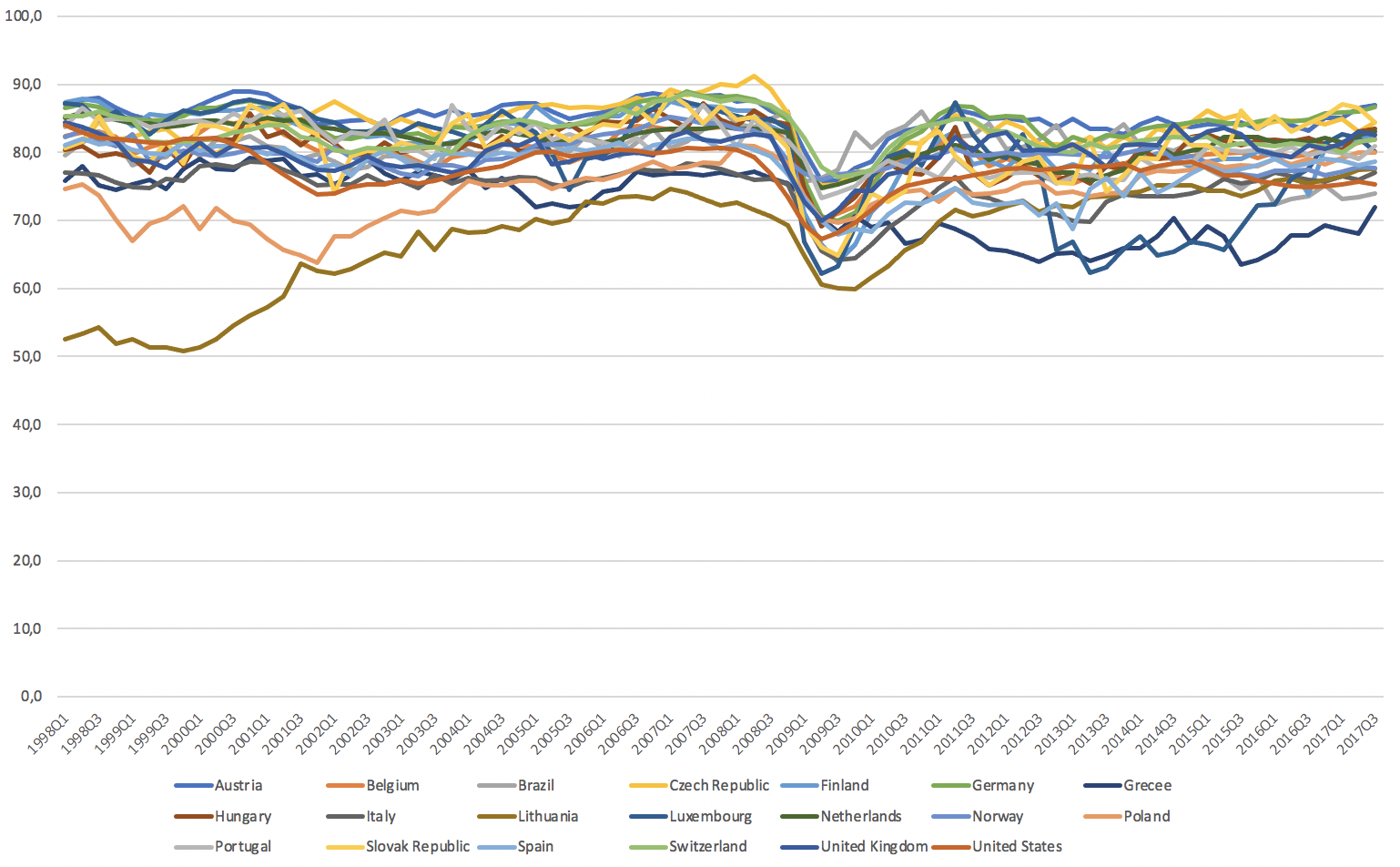
A stylised fact that characterises modern economies is that part of the installed productive capacity is persistently idle. By productive capacity I mean the productive equipment (mostly fixed capital goods) in existence, together with that part of the workforce which is required to operate it. As we can see in Figure 1, in countries as diverse as Belgium, Finland or Lithuania, the effective utilisation of installed capacity often gravitates below 100%, and around 80% on average worldwide.

Figure 1. Installed capacity utilisation by country (1998Q1-2017Q4).

Source: see Appendix I.

The academic consensus is that there are large margins of idle capacity planned by entrepreneurs. The reasons why entrepreneurs plan to operate with idle capacity vary according to the school of thought considered. At the risk of making a drastic simplification, we can say that while some authors think that entrepreneurs do so in order not to lose market share in the face of changes in demand, others tend to think that there is a rate of utilisation of installed capacity that does not accelerate inflation (Non-accelerating inflation rate of capacity utilisation, NAICU).

Read More »

What Happens to ‘Gender’ in Food and Agricultural Research? Mapping Four Broad Trends

By Merisa S. Thompson and Fiorella Picchioni

The Women and Development Study Group of the Development Studies Association (DSA) recently revisited Sally Brown and Anne Marie Goetz’s 1997 Feminist Review article ‘Who Needs (Sex) When You Can Have Gender? Conflicting Discourses on Gender at Beijing?’. The article examines challenges to the concept of ‘gender’ at the UN Fourth World Conference on Women in 1995, including debates on its institutionalization and depoliticization, the tendency for it to be used as a synonym for ‘women’, and the conservative backlash against the very use of the concept itself. The retrospective value of doing this showed just how relevant these questions continue to be for Gender and Development policy, practice, research and teaching today.

For example, when teaching sex and gender, critical feminist theorising can sometimes lead students to feel that Gender and Development (GAD) approaches are too instrumentalized, too much like an industry and disconnected from reality. Moreover, the positionality of working as ‘the gender person’ in larger projects, where the gender component is often seen to stand alone with little connection to other intersectional dynamics, remains an ongoing challenge. The increasing and worrying trend of an anti-woke ‘backlash’ against feminist analysis and gender equality across the globe was also a recurring theme.

We also considered how ‘gender’ as a concept is mobilised and used in food and agricultural studies specifically. In this blog, therefore, we examine what happens to the concept in food research, policy and practice, mapping out four broad trends. Firstly, the centring of the connection between gender, nutrition and mothering remains pervasive. Secondly, ‘gender equality’ is often instrumentalized as a tool to increase marketized forms of agricultural productivity. Thirdly, while a focus on gender is obviously welcome, it can in fact obscure other important axes of oppression, such as race, class, sexuality, disability and nationality. Finally, it is consequently crucial to ground research, policy and practice in historical specificity and context in order to take into account multiple underlying oppressions and structural inequalities that influence the ability of a range of different actors in the food system to participate both socially and economically.

Read More »

Walter Rodney’s Lost Book: One Hundred Years of Development in Africa

By Leo Zeilig.

One of the most astonishing books that Walter Rodney – the Guyanese revolutionary and historian – ever wrote was published several years after he was assassinated on 13 June 1980. The story of this book and how it came to be published is almost as remarkable as the life of the revolutionary himself. In 1978, Rodney was working as a full-time activist of the Working People’s Alliance (WPA) in Georgetown, the capital of Guyana. The WPA was a revolutionary organisation seeking to unite the African and Indian working class in the highly divided country, then run by the brutal Forbes Burnham. Rodney was the group’s principal organiser and intellectual, and to support himself and his family, and to fundraise for the WPA, he travelled overseas to teach and work.

One trip to Germany in 1978 shows us how his last book came to be. Rodney travelled from Guyana to Hamburg in April of that year. He was already the celebrated and outspoken author of How Europe Underdeveloped Africa, and his arrival was eagerly anticipated. He had been invited by the radical German scholar, Rainer Tetzlaff, to teach a course on the history of African development at the University of Hamburg.

The lecture course Rodney was employed to teach was titled, ‘African Development, 1878-1978’, and comprised, according to the one-page programme, ‘(i) a brief introduction to development concepts; (ii) a survey of African colonial economies with special reference to East and West Africa; and (iii) an examination of post-colonial developments in Kenya and Tanzania.’ According to the brief programme there were going to be twelve lectures, comprising, ‘The debate on development concepts in Africa’ and ‘Post-colonial development strategies’.1

Read More »

The Struggle for Development

This post is adapted from the preface for the newly published Turkish edition of The Struggle for Development, first published in 2017. The original edition aimed to root development thinking and practice in the analysis of class relations, and intellectual and political support for labouring class struggles. Turkey is experiencing numerous social struggles that illuminate the relevance of the arguments in this book. It is my hope that this book contributes to illuminating the social, developmental, value of these struggles.

Collective struggles by labouring class communities – in and beyond the workplace – have the capacity to generate real human developmental gains for these communities. Consequently, these struggles and the labouring classes that pursue them, should be considered as developmental.  

The majority of development thinking across the political spectrum – whether theoretically or policy focussed – tends to downplay labouring classes, their struggles and the gains they generate.  Rather, such struggles are usually ignored or are portrayed as obstacles to development, because they do not adhere to dominant capitalist notions of development. 

Capitalist notions and strategies of development take many forms, and can be thought of as existing along a spectrum – from more market-led/neoliberal, to more state-directed forms. In this book I argue that, despite notable differences, these forms of development represent varieties of capital-centred development. Here capital accumulation is prioritised as the basis of economic and human development. As I show in this book, both market led and state led forms of development are based upon the assumption that labouring classes represent an objective input into the development process, rather than a subjective agent of development. This assumption legitimates labour exploitation and repression for the greater ‘good’ of capital accumulation.  

Read More »