RMB internationalisation as an extension of Chinese state capitalism

wallpaperflare.com_wallpaper

Why has the RMB gone global?

More than a decade has passed since the launch of what is now widely known as ‘RMB internationalisation’, or the strategic attempt by the Communist Party of China (CPC) to expand the global reach and usage of the Chinese currency, the renminbi (RMB). Such is the scale and ambition of this strategy, some policymakers and scholars have proclaimed RMB internationalisation as a form of reserve currency succession – as a challenge to the US dollar as the world’s preferred currency for market exchange. This development is especially intriguing given how the financial system within China remains relatively insulated in spite of market oriented reforms since 1978. Could RMB internationalisation truly be about global currency supremacy when financial flows in and through China continue to be highly scrutinised?Read More »

Corporate Planning in the Coronavirus Economy

woman-wearing-mask-in-supermarket-3962289The global pandemic and associated developing global recession are calling into question a whole range of economic truths and demanding novel solutions to various interlinked societal problems. In this blog post, I want to connect what we’re currently seeing in the retail sector during this pandemic to deep-seated narratives about the nature of economic exchange, in particular to the notion of “the market”. 

The market is one of the most dominant concepts for making sense of the social world, primarily because of the prestige of the economics discipline and the elevation of the market concept by the discipline (albeit in a highly abstract manner). At its most basic, it paints the economic sphere as akin to a marketplace, where there is a level playing field and rivals compete for custom primarily through having the keenest of prices. Other, more complex, ideas often get laid over this concept, such as the market pricing mechanism allowing supply and demand to equilibrate, price signals communicating complex information to market participants, and, as such, the market allowing for decentralised decision making led by consumer demands. (For a much (much) fuller account of the market concept, see here.)

However, as a result of the coronavirus pandemic increased demand for basic goods – such as toilet roll, hand sanitiser and flour – has put a strain on the distribution of these goods and has engendered a response quite dissimilar to the narrative of the economic system as a competitive, decentralised, profit-maximising market. What we have seen, instead, is retailers working as sites of governance in order to ensure a degree of equity in the distribution of resources. Read More »

When does state-permeated capitalism work?

9780367203696

In recent years, state capitalism has become an important buzzword in the development economics discussion (again). In view of the very different ways in which this term is used, Ilias Alami and Adam Dixon recently highlighted the dangers of using the term too loosely in an article in Competition and Change. In view of its recent popularity, state capitalism could suffer a similar fate to the terms “neoliberalism” or “financialisation” by becoming a very loose rallying cry without any significant analytical value. To overcome this problematic situation, Alami and Dixon propose that future research should (1) develop a theory of the capitalist state, (2) circumscribe the time horizons of state capitalism, and (3) locate state capitalism more precisely in territorial and geographical terms.

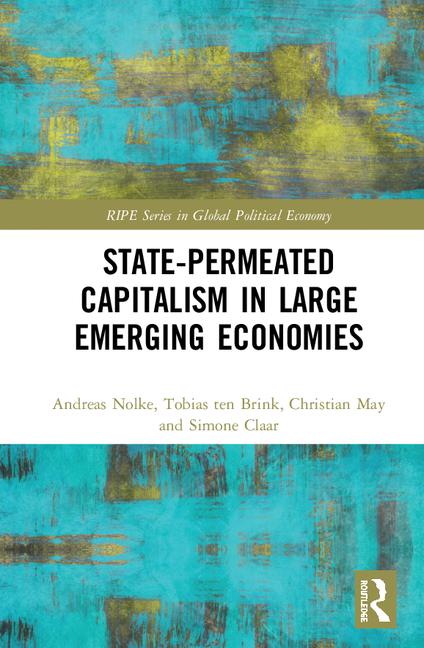
Although I am not sure whether the genius can be put back into the bottle by developing a unified theory of the state (too many different theoretical traditions are involved by now), I am very sympathetic to the latter two demands. Our recently published book “State-permeated Capitalism in Large Emerging Economies” (Routledge) is a modest contribution to the latter goals. It deals with the economic development of Brazil, India, China and South Africa between 2000 and 2015. Departing from a comparative capitalism perspective, we have developed an ideal type of state-permeated capitalism as opposed to liberal, coordinated and dependent capitalism – and examined to what extent large emerging markets are approaching this ideal type. Read More »

A crisis like no other: social reproduction and the regeneration of capitalist life during the COVID-19 pandemic

8M_Paraná_2019_13

Back to work!

As the COVID-19 health crisis deepens, it looks increasingly clear that the short-term collapse in global output is likely to exceed that of any recession in the last 150 years – that is, in the entire history of capitalism. The ILO estimates that the crisis will lead to the destruction of 195 million jobs. Hence, after discussing at length the epidemiology of the COVID-19 pandemic, media attention is now increasingly focused on how to restart the global economic engine. We may still be mourning our dead, but time seems to have come to discuss how we guarantee economic survival that, under capitalism, is based on production and work. Here in the UK, from where I am writing this piece, getting ‘Britain back to work’ is becoming the new mantra for the government, even if its own leader is still recovering from the virus. Similar concerns are debated across the world, as the pandemic has by now clearly turned from a planetary health threat into a planetary economic threat. Yet, getting the world ‘back to workain’t no easy endeavour, whilst maintaining social distancing. Global capitalism is based on social interactions. In fact, its global phase has aimed at erasing social distancing, not just between working people but also between countries, markets, commodities and consumers. But at present, the way in which we are used to regenerate life under capitalism would literally kill us, and this is no small print in explaining the impasse of the COVID-19 crisis. It should be the starting point to analyse it. Ultimately, before turning into a crisis of production, the current pandemic has created a systemic crisis of social reproduction. As argued by Tithi Bhattacharya, the pandemic has shown the centrality of life-making activities for the working of capitalism. Moreover, it has also shown the value of care, as well as the stark ‘care inequalities’ experienced by different communities and individuals across the globe. By all means, this is a reproductive crisis like no other before. Read More »

Pandemics and the State of Welfare

8215105852_95c45a755d_o

In the midst of what might possibly be the worst recession since 2008, and staring down the barrel of overwhelming economic, social and human disaster, there is widespread recognition that increased welfare spending is critical not just to contain the fallout from the pandemic, but also to effectively combat it. By ensuring timely delivery of essentials and basic income support, one can minimise the chances of people venturing outside, and hence contain the spread of the COVID-19 virus.

There are valid concerns raised as to whether these measures go far enough in helping workers or whether institutional mechanisms will be able to convert announcements into genuine progress on the ground. This blog post analyses the arguments behind the justification of introducing welfare schemes in today’s times, and the underlying economic logic behind them. 

The increase in welfare provision is sorely needed in a catastrophic situation such as the one we face. But while the readiness to deploy instruments to achieve this is unprecedented, the measures themselves are not. Much of the welfare measures rolled out by governments are standard income support and welfare packages, larger in scale but with no fundamental changes in their basic design. Much of these measures, moreover, have been advocated by many to deal with fallouts from economic crises in the past, only to be met with middling levels of success and acceptance by the powers that be. The impact of the coronavirus has shown us how quickly governments can turn over the fundamental principles of austerity if they are pushed to do so. 

This post does not simply aim to criticise government policies of the past in light of current actions, but to outline a warning for the future. The problem of economic distress will not go away once the pandemic does, because then we will be dealing with battered economies, high unemployment, and weak to non-existent growth. In such times, when the threat of the virus has ebbed, there will be calls to roll back the welfare measures of the government. These calls will have to be countered stringently, on the grounds that the need to protect welfare and ensure government assistance is not contingent simply on the existence of a virus, but on the inability of the economic machine to provide for welfare.Read More »

The Economics of being ‘Interesting’: Many kinds of exclusions

GER-LEWIS 2

This post engages with a conversational post titled Non-exemplary lives by Branko Milanovic. He is concerned with the current state of academia being filled with boring economists who have a CV full of publications but no experience of living and no interests outside work. Milanovic thus raises the question of how a lack of these influences impacts the profession of economics. 

While his is an apt observation, I think his questions can be broadened in many ways. For the sake of brevity, I will concentrate on a few. 

Exemplary Lives, but what kind of Examples? 

The notion of an ‘exemplary life’ is fraught with the possibilities of what a ‘non-exemplary life’ could be, and vice versa. To fully appreciate the scope of either, it is useful to question how the negation of the other can be fully gauged.

Put differently, is the ‘exemplary life’ really that exemplary- might there be a difference between the persona and the person? 

Consider what being an émigré has meant for two different economists: the Ukraine born Alexander Gerschenkron who settled in the US and the St-Lucian born Arthur Lewis who lived and worked in the UK.  Read More »

The Promise – and Pitfalls – of State-led Development in Resource-rich Countries: Resource Nationalism in Latin America and Beyond

miningThe eclipse of neoliberalism in 2000s coincided with the so-called commodity ‘super cycle’ that lasted between 2002 and 2012. In search of a new model, resource-rich states began to articulate resource nationalism as a development strategy. While ownership and control of minerals and hydrocarbons are intricately tied to claims of state sovereignty and exercise of political authority in development policy, resource nationalism can also be understood in terms of a power struggle between host states and global hegemons in their quest to secure resources for their own industrial needs. Hence, contemporary natural resource governance is reflective of the wider ideological return of the state despite two decades of reforms promoting market liberalization and privatization. Resource nationalism is a vital expression of the renewal of state agency amidst high external constraints imposed upon resource-rich countries.

Resource Nationalism as a State-led Development Strategy

It is not a coincidence that resource nationalism returned in mainstream political debates at the same time as emerging powers designed new industrial policies aimed at recalibrating state-market relations in favour of the former. With extraordinary high prices and rising demands for natural resources from China, domestic political configurations in resource economies appear to move towards reforms aimed at (1) capturing and maximising windfall profits amidst a boom, (2) extending the role of state in commodity production through a renewed role for state-owned enterprises, and (3) renegotiating the terms of contracts with multinational mining capital.

These policies are emblematic of a wider trend: the growing importance of state stewardship for industrial transformation in an era of cross-border production networks governed by global lead firms. Despite the rhetoric on economic globalization, the role of the state remains prevalent as observed in the number of state-owned enterprises, the significant expenditure on industrial policy, and the array of government-business partnerships in East Asia and beyond. State interventions are reconfigured not simply to reinforce the residual statist tendencies, but to actively construct new comparative advantages and build strong ties with economic elites who can compete in a globalized international economy. Perhaps, more importantly, political elites are forging new social contracts with ordinary citizens to enhance the legitimacy of the state, whether in terms of actively supporting social welfare programmes (as in the case of many conditional cash transfers in Latin America), or by creating new avenues to engage with marginalised groups (for example, through participatory institutions and FPIC process).

Amidst the resource bonanza, development plans were set in motion centred around the exploitation of natural resources. For example, Brazil launched a programme focussed on heavy investments in the capital goods sector, notably in oil, gas and ship-building industries.

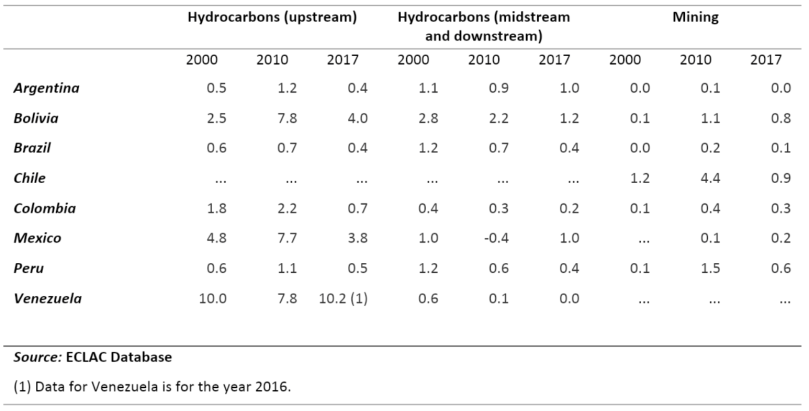
Several Latin American countries also introduced new royalty fees and export taxes aimed at capitalising on high prices. Table 1 details the increasing role of natural resource rents in state revenues over the past twenty years.

Table 1: Public Revenues from non-renewable natural resources in percentages of GDP
Screenshot 2020-03-24 at 09.33.07

Alongside attempts at adding value in mining and hydrocarbons, Latin American governments faced redistributive pressures from their political base. ‘Compensatory states’ justified their resource extraction strategy as a necessary step for further income distribution and revitalization of manufacturing. While political citizenship in post-neoliberal Latin America is increasingly defined by redistributive politics, it also emphasised recognition and identity politics as a central feature of a contentious state-society relationship.

The Limits of the Resource Bonanza

It is now a widely held view that the Left-of-Centre governments successfully reduced poverty and extreme poverty (see Table 2), and although slow, inequality has begun to taper off (Figure 1). However, the data also confirm the fragility of the social achievements of Latin American governments – as the bonanza ended, so did the gains from poverty reduction. This points to several important shortcomings of resource-based strategies.

Figure 1 Gini Inequality Index in Latin America, 2002-2018

Screenshot 2020-03-24 at 09.29.28Source: CEPAL 2019

Most conspicuously, poverty gains may have created a trade off in making vital investments in the productive economy. Finite domestic revenues have been subject to immense political competition for rent-seeking, and without a coherent industrial strategy, an export-led growth model based on commodities are likely to be fragile and is vulnerable from price swings.

This, then, leads to a gloomy conclusion. Resource-rich states, without the institutional capacity to design a productivist strategy to diversify their export base and to set out an ambitious multi-year development plan to upgrade their industrial sectors, are likely to suffer from the vicissitudes of international commodity markets. At worst, those without political consensus over governance – Venezuela under Maduro being the emblematic case – are likely to waste the opportunities for development through their strategic mining sectors. The broader lesson, I suspect, is that institutional preconditions and pro-industrial policy coalitions are central to the success of developing countries advancing new strategies in an increasingly globalized international economy. Crucially, whenever crisis and uncertainty appear, the state as a stabilizing force becomes more prescient than ever.

Table 2: Poverty and Extreme Poverty in 18 Latin American Countries, 2002-2019 (in percentages)

Screenshot 2020-03-24 at 09.34.27

Jewellord (Jojo) Nem Singh is an Assistant Professor at the Institute of Political Science, Leiden University working on the political economy of development and democracy in Latin America and East Asia. He tweets at @jnemsingh.

COVID-19: A Bigger Challenge to the Indian Healthcare System

piqsels.com-id-fjlen

Covid-19 has reached the community spread phase. Developed or underdeveloped, rich or poor, all countries are affected by this today. However, they are facing these challenges – shortages in medical supplies and difficulty stopping its spread – in different magnitudes. In an attempt to stop the spread to save lives, Prime Minister Narendra Modi announced a 21-day lockdown, starting from 25th of March. Developing countries across the globe are looking down quickly, after witnessing the helplessness of the US, UK and the rest of Europe – though these are the countries with much stronger healthcare systems and much better availability of doctors. In Italy, doctors are forced to prioritize whom to save and whom to leave untreated.

India’s healthcare infrastructure is incapable of dealing with this crisis today. Shortages in medical supplies and an inability to provide adequate testing are the major issues. However, the Prime Minister’s announcement to allocate 15,000 crore rupees (USD 2 billion) for building infrastructure can strengthen the fight against coronavirus. Also, state governments are trying to expand facilities to deal with this situation.

The majority of Indians finance their healthcare themselves. About 62 percent of households’ expenditure on healthcare in 2017 was made through out-of-pocket payments. In comparison, the equivalent figures for the European Union (excluding UK) is 22.29 percent and for the USA and UK it is 11 percent and 16 percent, respectively (Table 1). While many patients diagnosed with Covid-19 will need Intensive Care Unit (ICU), there is no clarity from the government regarding who will pay these expenses. Read More »