The drama surrounding President Trump’s decision to impose import tariffs on steel and aluminum has roiled the Republican Party and wide swathes of the corporate elite. The tariff decision comes on the heels of political bluster about the US being treated “unfairly” by other countries. This accusation of “unfairness” when it comes to US trade deficits is well worn. In a previous era, Japan was the alleged culprit of “unfair” trade practices because of its persistent trade surpluses with the U.S.Read More »
Andrew Simms (New Weather Institute), Sally Svenlen (RE student), Larry Elliott (Guardian), Steve Keen (Debunking Economics) and Kate Raworth (Doughnut Economics) symbolically nail the “33 Theses” to the door of the London School of Economics in December 2017. rethinkeconomics.org.
On the occasion of the 500th anniversary of Martin Luther’s Reformation, 33 Theses for an Economics Reformation were formulated by Rethinking Economics and the New Weather Institute. The document was symbolically nailed to the door of the London School of Economics In December 2017 and endorsed in The Guardian, and was supported by an impressive list of over 60 leading academics and policy experts. The initiative offers a rare and most welcome refreshing message from the House of Economics.
Several elements in the theses are long overdue – for example, the existence of planetary limits, the superiority of political deliberation over economic logic, the appreciation of the role of uncertainty in economic predictions, the non-independence of facts and values when economic thoughts are formulated, the warning against over-reliance on modelling, econometrics and formal methods. Also important is the indication that both growth and innovation need to be conceived with a desirable end in sight, one which can be associated with material and spiritual progress – rather than with misery, inequity and inequality. It is finally all important that in the teaching of economics itself the history and philosophy of economics should be taught, together with all economic theories: not just the family tree of mainstream economics.Read More »
The discussions of the processes behind the growing importance of finance, financial transactions and financial motives, as well as the sustainability of the financial systems, have been located in the critical political economy debate of financialisation and neoliberalism (Crotty, 2003; Epstein, 2005; Fine, 2013; Lapavitsas, 2013; Palley, 2016; Sawyer, 2013; Stockhammer, 2004).
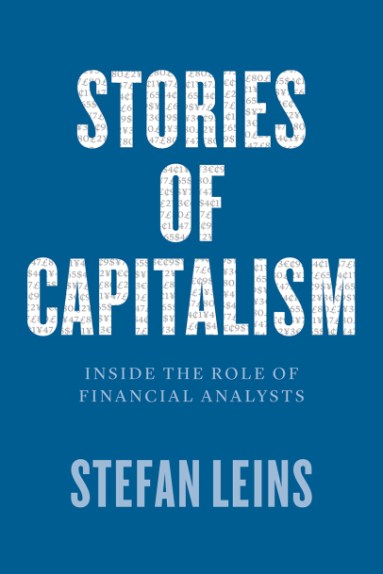
Since the emergence of modern financial markets, financial analysts have played a critical role in producing visions of “the economy” and its future development. As experts, they analyze market developments and predict future scenarios that enable other financial market participants to speculate on the rise or fall of stock prices, the success or failure of particular investment products, and the growth or decline of entire national economies. The substance of the analysts’ valuation and forecasting practices is, however, heavily disputed among economists. In neoclassical economic theory, the assumption that markets are informationally efficient has challenged the legitimacy of the work of financial analysts since the establishment of the efficient market hypothesis as a central paradigm in the mid 1960s. Alternative schools of thoughts – such as new institutional or behavioral economics – have criticized this paradigm. However, they have also argued that the degree of uncertainty, which is inherent to financial markets, makes prediction impossible.Read More »
By Aleksandr V. Gevorkyan (St. John’s University) and Tarron Khemraj (New College of Florida)
In May 2016, economist Kenneth Rogoff argued that central banks in emerging markets should add gold to their reserves. Rogoff stated “that a shift in emerging markets toward accumulating gold would help the international financial system function more smoothly and benefit everyone.” Despite initial disagreement, we find there may actually be some justification for this view in a recent paper coming out in Emerging Markets Finance and Trade.Read More »
I have lately been grappling with the question of how African states came into being, not just as political, but especially economic territorial units. Connected to this are questions of how experts, especially economists came to influence and account for what became national economies. At the center of the state, economy and society are critical question of development and welfare. How did independent African countries make sense of their inheritance and what mechanisms did they deploy to transform themselves into coherent nations of multiple but entangled identities with disparate circumstance but common material goals united by the logic of a national economy? As I grappled with these issues, a great new monograph informed by an impressive historiography has arrived. The author grounds his work in an archivally based history of the transformation of the Sudan into an economic unit between the 1940s and the 1960s. Alden Young’s new book: Transforming the Sudan: Decolonization, Economic Development, and State Formation (Cambridge: Cambridge University Press, 2017) is centred on addressing these question using the history of a territory that transformed from being an Anglo-Egyptian Sudan condominium into the independent state of Sudan.Read More »
The theme of the 2018 World Economic Forum was, “Creating a Shared Future in a Fractured World.” Its six richest attendees each boasted an estimated net worth of $5.2 billion or more, or the same amount as the total burden of Somalia’s outstanding debt, which, amid the splendor of the event, Somali Prime Minister Hassan Ali Khayre met with IMF Managing Director Christine Lagarde to discuss clearing. In this era of extreme global inequality, it is estimated that the United Nations agenda of seventeen sustainable development goals (SDGs) known as Agenda 2030, will require 4.5 trillion dollars of investment per year to be realized, or more than twice the amount expected to be available from traditional official development assistance (ODA) alone. Due to the increasing concentration of private wealth in the global economy, discussions around development finance have focused on private sector engagement, rather than more traditional, ODA from predominantly Western donor governments and multilateral institutions.Read More »
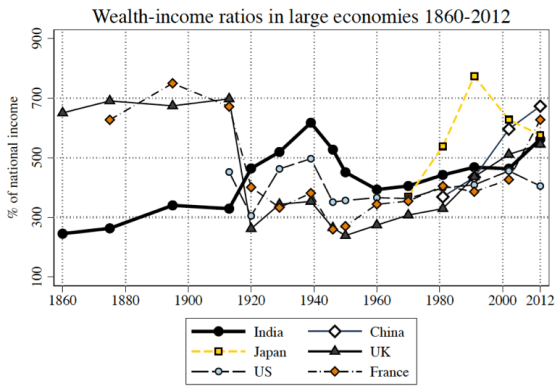
Wealth-income ratios are rising everywhere – they are not cyclical but rather unambiguously upward trending for the past three decades. Put simply, the accumulation of wealth is outpacing economic growth. This is true in America, Europe and Japan (Piketty and Zucman 2014), as well as China and Russia (Novokmet, Zucman & Yang 2018). In recent research (Kumar 2018), I found this same trend to persist in the world’s largest democracy – Indian wealth-income ratios have been rising since the 1970s. Why are these trends so similar in countries with such deep structural differences and distinct economic trajectories? By themselves, high wealth-income ratios are not necessarily a social dilemma – they may imply more wealth for everyone. But in general, there is a tendency for wealth to be more concentrated than income. As a result, a rise in wealth over income tends to increase wealth inequality. This is certainly the situation in most economies today. Thus, these trends and the mechanisms behind them need to be understood with careful attention.





 Developing Economics