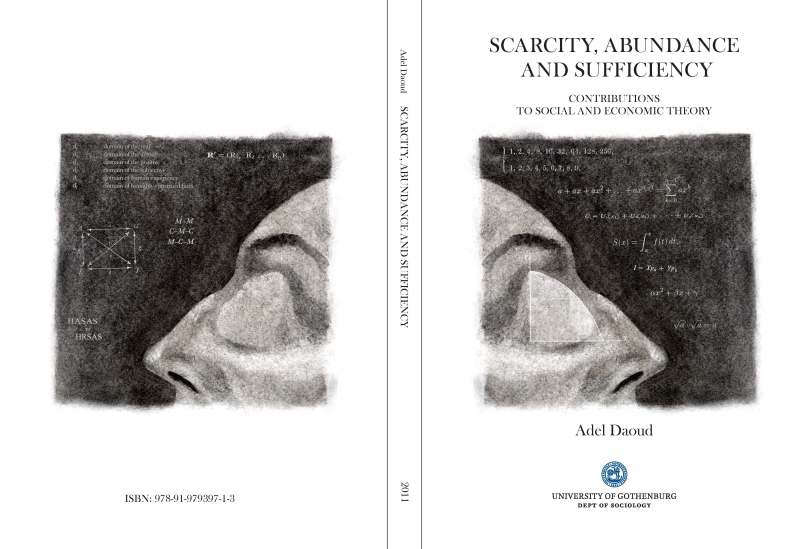
 The marginalist revolution in the late nineteenth century marked the beginning of the end of classical political economy and the birth of what came to be known as neoclassical economics (Sandelin et al. 2002). All three pioneers of marginal utility theory—Carl Menger (1871), William Jevons (1888), Léon Walras (1954) —referred to scarcity as the starting point for economic analysis. Through the work of these pioneers, especially Menger’s, the centrality of scarcity became a core premise for the advancement of contemporary neoclassical economics (see Hayek 2004:19; Robbins 1998:277). As a result, virtually every neoclassical economic textbook refers to scarcity—even though the field of economics is becoming increasingly differentiated.
I have argued in my research that scarcity problems are, and will remain, an important sub-set of problems, but we need to include sufficiency and abundance problems as well (Daoud 2007, 2010, 2011a, 2011b, 2015, 2017). Under scarcity, economics will give us insights about how people optimize their behavior to get as much as possible out of their limited resources. Neoclassical economics is mainly interested in what we can call allocation problems under a scarcity assumption. If actor A has a set of resources R, that is scarce in relation to fulfilling a set of wants W. Neoclassical economics tells us that a rational actor will optimize his or her resources in such a way that person can derive as much utility U as possible given the circumstances. These types of problems are central to many social science issues—they face governments allocating a limited budget to a myriad of popular demands, they face the individual in deciding if he or she should go to university or take a job. As social scientist, we need to keep analyzing these situations.Read More »






 Developing Economics