Debating ‘State Capitalism’ in Turkey: Beyond False Dichotomies

Following the 2016 failed coup attempt, and in the context of increasing mistrust towards the West, Turkey’s president Erdogan reflected his discontent with the EU and argued that Turkey should instead join the Shanghai Five, namely the Shanghai Cooperation Organisation (SCO) led primarily by China and Russia. Soon after, despite being a NATO member, Turkey signed a deal with Russia to buy the S-400 air defence missile system. Taken together with Turkey’s other ‘adventures’ in its region, these developments were perceived as manifestations of a changing political economy of Turkey, and were deeply disturbing to Western powers. After all, since the end of the Second World War, Turkey had been a close ally of the US-led Western capitalist bloc, it continued to be one during the Cold War; and had remained very close to US and EU interests following the end of the Cold War in 1991.

For some accounts[i], these developments are related to the changing world order and global power shifts following the 2008 crisis, as the decline of the ‘liberal international order’ and the rise of BRICS (Brazil, Russia, India, China and South Africa) marked transformations of the global political economy. Hence, there is a tendency to explain Turkey’s late political economy in this context. It is argued that, in this ‘post-liberal international order’ where two competing political economies come to the fore, Turkey is moving towards the ‘East’ or ‘non-West’ – mainly China and Russia. As such, Turkey’s engagement with non-Western ‘great powers’ (which are generally characterised by ‘authoritarian state capitalism’ as opposed to the ‘neoliberal political economy’/liberal democracy/’democratic capitalism’ of the West), shapes Turkey’s political economy and paves the way for ‘authoritarianism’, ‘illiberal democracy’ and ‘state capitalism’. Put differently, as the legitimacy crisis of ‘Western neoliberalism’ makes it less desirable for countries like Turkey, Turkey is regarded to have deviated from neoliberalism and liberal democracy and moved to state capitalism and authoritarianism.

Read More »

“Under pressure”: negotiating competing demands and desires in a time of precarious earnings

A few years ago, during a year of ethnographic fieldwork with young un(der)employed men in a poor shack settlement on the outskirts of Johannesburg, I found myself sitting in Senzo’s one-room shack on a foldout camping chair. It was a hot Wednesday afternoon. Popular R&B music was blaring into the air from the nearby tavern. Senzo sat on his double bed. Soon after I arrived, Senzo handed me an ornate invitation with gold foil on the sides and his name on it. It was an invitation to the wedding of his cousin that was set to take place the following weekend. I asked Senzo if he planned to go. “I’m not going”, he told me, explaining that he had declined the invitation because, as he put it, “I don’t want to put more pressure on myself” describing the difficulties he already had paying rent, keeping up with outstanding debts, and supporting his girlfriend and children. Going to the wedding would require him to buy a fancy suit and a gift for the couple. This required money he didn’t have. The “pressure” Senzo described was not just the monetary cost of attending the wedding. It was also the feeling (what Senzo called “stress”) of being overburdened by competing demands on his money including buying consumer items, sending his children to good schools, and supporting family members. To understand the continuous “pressure” young men like Senzo face requires we give attention to the changing nature of work and the changing world of families in contemporary South Africa. As I show below the pressures young black un(der)employed men experience are at once economic and social given the pressure they face to not only “provide” for themselves and their families exists alongside a pressure to improve or “upgrade” their lives. As such, I show how the   “income-demands gap” (a key catalyst of “pressure”) in young men’s lives is produced in and through specific (increasingly temporary rather than enduring) social relations and ties. 

Read More »

The Agrarian Crisis in Punjab and the Making of the Anti-Farm Law Protests

The protests in Punjab are happening at a time when the agrarian economy is under stress. With increasing uncertainty, previously antagonistic groups across classes, castes & gender are coming closer, building a broader base for the agitation & beyond.

Punjab’s farmers have been unrelenting in their opposition to the new farm laws passed in September. Their sustained and creative opposition continues to make headlines. The central government too remains adamant and increasingly belligerent about sustaining the laws in their current form. The political pressure of the farmers has led the Punjab government, in a symbolic gesture, to pass legislation rejecting the centre’s farm laws. The past weeks have witnessed bitter stand-offs: farmers blocking rail tracks, the railways suspending services to Punjab for a period, and the state’s power plants starved of coal. A march of thousands of farmers to Delhi earlier this week to register their opposition to these laws is faced police barricades, water cannons, and tear gas shells.

In the face of the unpopularity of the farm laws, the central government has found refuge in different kinds of arguments in favour of the reforms. It has sought to discredit the protests by arguing that the agitation is driven by exploitative middlemen, and that small and marginal farmers are happy with these laws. The opposition to the new laws is portrayed as coming from large, prosperous, and politically powerful farmers, who dominate Punjab’s farmers unions and who benefited the most from the old system.

Read More »

Economic Sovereignty for Developing Countries: What Role for Modern Money Theory?

With modern money theory (MMT) receiving impressive attention, the implications this theory has for developing countries have also been discussed more intensely. Emphasizing both its strengths and gaps provides a great chance to further develop macroeconomic strategies for poverty reduction and environmental sustainability.

In brief, the theory starts from the statement that money is issued by the government and brought into circulation via its expenditures. The government does not rely on taxes to fund expenditures when it is itself the source of money. Therefore, money can be created upon demand, is not limited, and can be used by the government to finance all expenditures it considers necessary to achieve policy goals such as full employment or a Green New Deal. The reason why agents in the economy accepts this money only consisting of numbers without any intrinsic value is the obligation to pay taxes. Since the state has the power to impose taxes, individuals need to get hold of money as this is the only way to meet their obligations; this is how the currency is accepted as a means of payments. The government thus has the power to run unlimited deficits because the fact that money is needed to pay taxes guarantees its acceptance even if those taxes do not cover expenditures. In fact, the government should run deficits because it creates the demand required for full employment while a balanced budget constrains it. The government cannot go bankrupt because there is no lack of currency it issues itself. The conditions identified by MMT for the system to work are the following: 1) the country must be sovereign of its own currency and 2) inflation needs to be kept under control. Once the latter starts accelerating due to increased nominal demand stemming from government expenditures, taxes can be increased in order to withdraw money from circulation. However, as long as full employment is not achieved, prices are argued to remain stable.

Read More »

Does India’s Gender Budget Need a Rethink?

India was a pioneering country when it first introduced a Gender Budget in 2001 as part of its annual Financial Year Budget. Gender Budgeting (GB) highlights the inherently different experiences in receiving financial and welfare support from the state due to their differing needs, priorities and access and serves to ameliorate the barriers to economic inclusion faced by women through a plethora of state financing. 

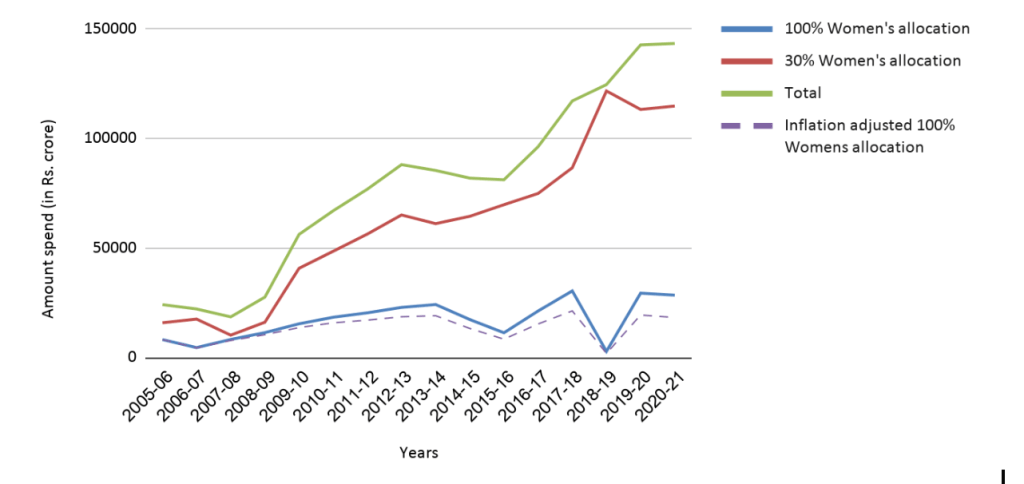
India’s Gender Budget Statement (GBS) has been released in two parts since 2005. Each ministry highlights allocations that are – women specific allocations where 100% of the budget for a specific scheme is assigned to women and a ‘pro-women’s’ allocation, where at least 30% of the budget for a specific scheme has been assigned to women to enhance affirmative action.

Figure 1: Proportion of women’s allocation in India’s Gender Budget

Read More »

Haemorrhaging Zambia: Prequel to the Current Debt Crisis

Following a stand-off with commercial creditors and protracted but unresolved negotiations with the IMF, Zambia defaulted on its external sovereign debt on 13 November this year. While most commentary has focused exclusively on the government’s sovereign borrowing, our own research has detected massive outflows of private wealth over the past fifteen years, hidden away on an obscure part of the country’s financial account. The outflows are most likely related to the large mining companies that dominate the country’s international trade. With many other African countries also facing debt distress, the lessons of this huge siphoning of wealth from the Zambian economy need extra attention within discussions about debt justice in the current crisis. We explain here what we’ve found.

Zambia was already debt-stressed going into the COVID pandemic. The economy was hard hit following the sharp fall in international copper prices from 2013 to 2016, especially that copper made up about 72% of its exports in 2018 (including unrefined, cathodes and alloys). Following a severe currency crisis in 2015, the government entered into negotiations with the IMF but never agreed on a programme. There was some improvement in macroeconomic outlook in 2017 due to rising copper prices, which sent international investors throttling back into optimism. However, international investors again turned against the country in 2018 in the midst of the global emerging market bond sell off, which compounded the effects of severe droughts in 2018-19. As a result, the government was already teetering on the edge of default on the eve of the COVID-19 pandemic. The economic fall-out of the pandemic has since pushed the country over the edge (see an excellent analysis here).

Read More »

Knowledge Divides

This post was originally published on Menelique Magazine, issue #3 and menelique.com.

#Black Lives Matter highlights the suppression of black lives in all aspects of society, but the public interest in the movement has been limited to systemic state racism involving the brutality of white police officers against black people. The visible and visceral discriminations in the public domain are serious and warrant such interest and concern, but this focus leaves out several other issues that are of interest to the movement. 

The intellectual marginalisation of black people is one of such relatively overlooked areas. When black intellectual suppression is recognised, it is commonly held to be a mere supply problem. In this sense, black people produce little or no knowledge, there are few or no serious black scholars to engage, or the work of black scholars is not good enough. Conventional indices appear to bear out such claims. From 1987 to 2016, for example, a World Bank report suggests that the share of Africa’s contribution to the global pool of scientific knowledge as measured by scientific databases such as Web of Science declined from 1 to under 1 per cent. 

Read More »

Return of the Bond Villains

In 1825 a Javanese prince named Diponegoro touched off a five-year, ultimately unsuccessful, war of resistance against the Dutch colonial government. As detailed by Peter Carey in his biography of Diponegoro, one of the causes was a land-rent system imposed by the Dutch on the Javanese sultanate of Yogyakarta. Under this system, landowners were encouraged to rent their estates directly to European plantation owners for the production of cash crops. This had a disruptive effect on the local economy and the Governor-General ordered it halted. But there was a catch. As the land-rent system was unwound, the Javanese landowners were forced to buy out the plantation owners in order to get control of their land back.

Many had already used the rents to buy imported luxury goods, and they fell into debt paying out large and often inflated sums to the plantation owners. The sultan was expected to back-stop these debts using payments he received from the Dutch for granting them the right to collect revenue on the kingdom’s toll roads. This created a situation where a Javanese merchant travelling from Yogyakarta to Semarang had to pay fees to the Dutch toll road agents. A portion of those fees then went to the sultan, who used them to back-stop debts being incurred by Javanese landowners as they bought back their own land back from European plantation owners.

Read More »