
“The ‘market’ is a bad master, but can be a good servant.”
– S. Chakravarty (1993: 420)
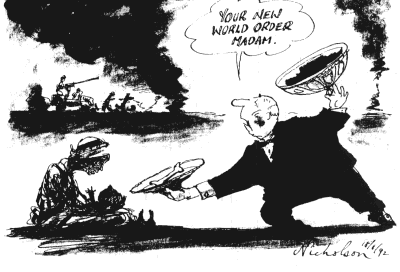
In the world today, more and more interpersonal interactions are replaced by market transactions. The market system is both an economic and a cultural phenomenon, yet we seem to be hardly aware of the values that are bound up in it. This phenomenon is manifest at many levels: from the family, through the neighbourhood and the enterprise, to the nation and the globe. If there is such a thing as global ethics, I suggest, then they are – like it or not – the ethics of the market. My purpose here is to elaborate this claim, and to assess its implications. I shall distinguish between the market as a theoretical construct in economics, and the market as a social institution.
My main hypothesis can be briefly stated as follows: the most convincing ethical argument currently being made in favour of the market is its neutrality. Whether the market is in fact neutral may be disputed. But if one accepts this claim, it implies that the market is amoral, rather than immoral, and there remain, I suggest, two objections to allowing the market ethic to prevail. The first is that this is an abrogation of moral responsibility. It implies delegating decisions of major social and material significance to powers which are beyond our control, and whose outcome is uncertain. Second, the neutrality of the market comes at a cost in social and human terms; social relations between persons are replaced by contractual relations between economic agents.Read More »



 Developing Economics