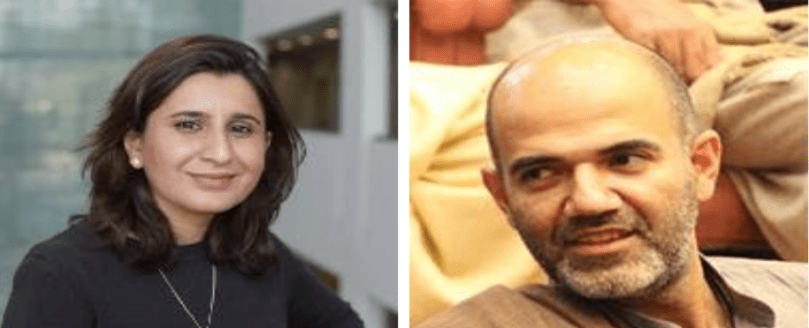
A conversation with and Dr. Juvaria Jafri and Dr. Aasim Sajjad.
Aasim Sajjad Akhtar is Professor of Political Economy at the National Institute of Pakistan Studies, Quaid-e-Azam University and a founder of the Awami Workers Party (AWP). His research has focused on state theory, informality, colonial history, rise of the middle classes and social movements in Pakistan. His latest book is ‘The Politics of Common Sense: State, Society and Culture in Pakistan’.
Juvaria Jafri is a Lecturer in International Political Economy at City University. Her research is on financial development in Pakistan, including inclusive finance, fintech, and impact investing strategies. Her latest co-edited book is ‘Geofinance between Political and Financial Geographies: A Focus on the Semi-Periphery of the Global Financial System.’
Introduction
The full impact of the COVID-19 pandemic on developing countries is still unfolding. While many countries have managed to achieve some stability in eliminating the spread of the crisis, others are struggling on various fronts. In South Asia, India has received much global attention owing to the violence of a hasty lockdown which was imposed without warning and an accompanying social safety net. Other countries in the region including Bangladesh, Srilanka and Nepal also continue to grapple with the existential question of how to ensure that contagion control does not come at the expense of destroying livelihoods.
In this interview we focus on the situation in Pakistan. We invited Aasim Sajjad and Juvaria Jafri to address some questions related to the current situation in Pakistan. The following four questions were designed to provide a glimpse of how the pandemic is impacting the existing socio-economic structure of the Pakistani economy particularly focusing on class inequality, fin-tech as a potential solution and the activist and citizen-led first historic demand for a long-term welfare package.



 By
By 
