Philanthropy in Development: Undermining Democracy?

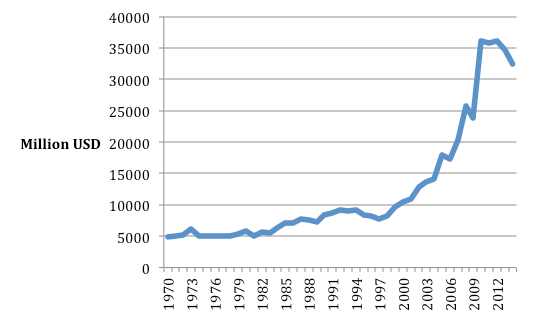
The word philanthropy dates back to the Greek word φιλανθρωπία, which means the love of humanity. Today the OECD defines private philanthropy as non-official development assistance (ODA) to developing countries. Such assistance can be through large philanthropic foundations such as the Rockefeller or Clinton Foundation, or through ‘direct giving’ platforms such as Global Giving or Kiva. But does what we call philanthropy today deserve its name? Rather than focusing on the actions of specific philanthropic organizations, this piece will assess the impact the rise of philanthropy has on global governance and democracy.

Figure 1: Grants by private agencies and NGOsScreen Shot 2016-10-16 at 17.03.14.png
Source: OECD data

Read More »

The Trouble with Sub-Saharan African Debt

By Aleksandr V. Gevorkyan and Ingrid Harvold Kvangraven

Over the past decade, the Sub-Saharan African countries’ ability to draw on new debt in international capital markets has become a central characteristic of their development experience. Yet, the determinants of their borrowing costs are driven by external factors where investor perception plays a key role. This raises concerns over the sustainability of the current development model.

In the mid-2000s, 30 African countries received substantial debt reduction through the International Monetary Fund (IMF) and World Bank’s Heavily-Indebted Poor Country (HIPC) Initiative. Only a decade later, many of the same countries are again facing debt distress. The African Development Bank recently warned its members of the dangers of rising debt obligations, while the IMF has called for an “urgent need to reset” the region’s growth policies.

In our new paper entitled “Assessing Recent Determinants of Borrowing Costs in Sub-Saharan Africa” in the November 2016 issue of the Review of Development Economics, we trace the latest round of borrowing back to 2006 with Seychelles as the first sub-Saharan African (SSA) country to issue a sovereign bond, with the exception of South Africa, in 30 years. Since then, DR Congo, Gabon, Ghana, Côte d’Ivoire, Senegal, Angola, Nigeria, Tanzania, Namibia, Rwanda, Kenya, Ethiopia and Zambia have all followed suit, accumulating over $25 billion worth of bonds, with a principal amount of more than $35 billion (see Figure 1 for totals by country).Read More »

The New Secretary-General, and the Next: Reforming International Appointments

un_general_assembly_hall

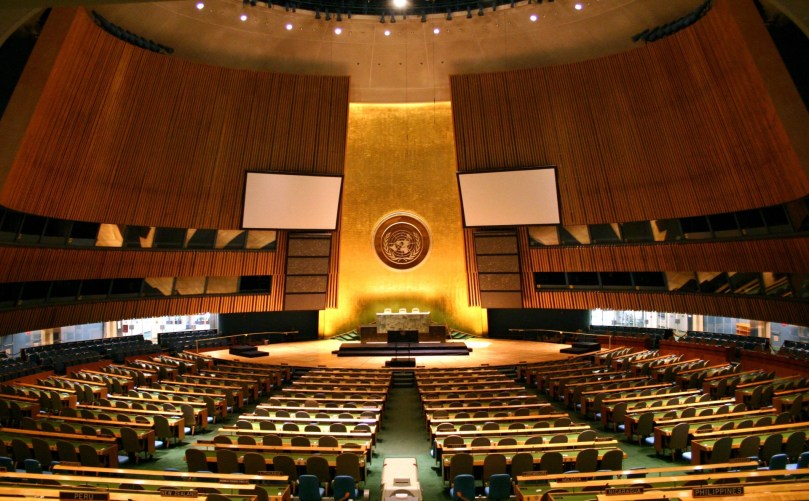
The UN selected António Guterres as its new Secretary-General this week. Economics Professor Sanjay Reddy offers his thoughts on the deficiencies in the selection process, reform possibilities, and the future trajectory of a UN led by Guterres. Drawing on his experience as a member of the UN Economic and Social Council’s Independent Team of Advisers, Reddy argues that the UN system needs much more than the ‘fine tuning’ that Guterres has in mind.

Sanjay G Reddy's avatarreddytoread

The announcement that the new Secretary-General of the United Nations will be Antonio Guterres of Portugal brings to an end a process of making this important appointment which has been more transparent than ever (as it included such innovations as a public debate between declared candidates). However, despite the credentials of the new Secretary-General and his laudable intentions for the organisation, the process has highlighted the continued deficiencies in the selection process, including but not confined to lack of full transparency, in particular on the basis of the final decision.

View original post 1,261 more words

The Market or the State: Why Polanyi Still Matters

Screen Shot 2016-09-30 at 10.11.05.png

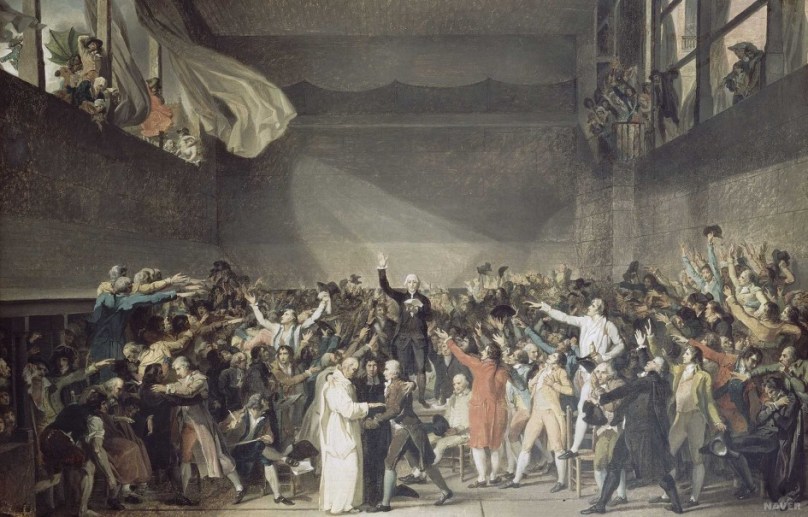
During the 1990s, although the market paradigm was dominant in economics and public policy, a new literature stressing the importance of the role of the state in industrialization rose to fame. We can mention Alice Amsden’s Asia Next Giant (1989), Robert Wade’s Governing the Market (1990) or Peter Evans’ Embedded Autonomy (1995). This literature dwelled on the East Asian miraculous industrialization and showed with empirical and historical evidence how the state apparatus was necessary to spark the economic take off. More recently, these academic attempts multiplied (for instance in the developmental state literature with Ha-Joon Chang’s Kicking away the Ladder, 2002) and gained new interest after the 2008 financial crisis. Yet, this literature is not novel and draws its inspiration from previous economists and social scientists, who for a long time warned us of the danger of disintegrating the state from the economic sphere. On the other hand, mainstream theorists tend to undermine, if not ignore, state intervention and consider it as an exogenous variable to economic growth (see for example Bela Balassa, Lord P. T. Bauer, Anne Krueger and Deepak Lal). The post-1980s era had provoked academic debates around the role of the market versus the role of the state for developing countries: the claim made by mainstream economists and politicians was that countries which pursued a state-led industrial policy failed greatly and that the Latin-American debt crises was an illustration of this (see for example the 1983 World Development Report). On the contrary, it was observed that the East Asian newly industrialized countries (the so-called ‘four tigers’) ‘miraculously’ developed by pursuing market-oriented policies (see for example the World Bank). As heterodox economists, such as Amsden, Wade, and Evans, retaliated by stating the exact opposite, the extent to which the state could be an industrial actor or not become a new agora for both camps.

However, what if the terms of the debate were problematic at the conceptual level from the beginning? Is the dichotomy “state vs. market” as evident as it appears to be in policy debates? A theoretical detour going back to Karl Polanyi might help us shed some light on this issue.

Read More »

Africa: Why Western Economists Get It Wrong

2-3-_unpacking_african_numbers_10070552376Morten Jerven, image via Wikimedia

Development economics as a field of study was formally launched in the 1950s by the Afro-Caribbean economist Arthur Lewis who, out of necessity, wanted to understand how his own country, Saint Lucia, could transform from an agro-based economy into a modern industrial state (later, in 1979, Lewis was awarded the Nobel Memorial Prize in Economics for this work, the only black person to have won the prize to date). For Lewis, the key to providing a satisfactory answer to the problem of underdevelopment lay in studying those societies as they were and not in comparing them to some mythical ideal. Saint Lucia, like all developing countries, had a lot of underemployed labor in its agricultural sector. The question was how best to marshal this valuable resource into driving industrialization.

Sadly, development economics has moved away from Lewis’ pioneering contribution of studying poor countries on their own terms. For example, today’s development economists explain Tanzania’s lack of development as stemming from its inability to be more like Sweden. This way of studying development, termed the “subtraction approach”, has led us down a dark alleyway where there is more confusion than elucidation. That, at least, is the charge leveled by economic historian Morten Jerven in his book Africa: Why Economists Get It Wrong published in 2015, but still circulating and prompting debate in academia and amongst practitioners.

Read More »

What do we know about the wealthy in India? A case study prior to liberalization

The first modern book in economics was called the “Wealth of Nations” because its writer, Adam Smith understood (and transmuted the idea) that the key to prosperity and growth was the generation and distribution of wealth – not just the flow of income. Recent interest in economics has started to return to this question especially in the context of today’s rich countries. The academic attention on the metamorphosis and concentration of wealth has so far excluded poor countries. In fact the study of the wealth of poor nations should be a core question in development economics (over income growth) because wealth tends to cumulate all past prosperity or disparity.

I found it notable that despite the detailed historical analysis in Piketty’s book Capital in the 21st Century, there was no mention of Indian wealth (Piketty did study top Indian incomes). To an extent this is understandable because data on India is so limited and unreliable that documenting it would require a book in itself. Till date, the Indian central bank (RBI) does not follow the tradition of publishing regular household and private sector balance sheets at market value, to assess accumulation and asset prices. And yet due to its sheer size and importance, India presents a unique challenge to the notion of prosperity – it is simultaneously home to some of the wealthiest and poorest global citizens. In the past, the question of India’s colonial subservience was related to the drain of wealth, rather than income – the British enriched themselves at the cost of their prized colony. What happened once India became independent?

indiapic1-jpg

My new paper “Capital and the Hindu rate of growth: Top Indian wealth holders 1961-1986” tries to answer this question for a particular historical phase in Indian history. Read More »