Pandemics and the State of Welfare

8215105852_95c45a755d_o

In the midst of what might possibly be the worst recession since 2008, and staring down the barrel of overwhelming economic, social and human disaster, there is widespread recognition that increased welfare spending is critical not just to contain the fallout from the pandemic, but also to effectively combat it. By ensuring timely delivery of essentials and basic income support, one can minimise the chances of people venturing outside, and hence contain the spread of the COVID-19 virus.

There are valid concerns raised as to whether these measures go far enough in helping workers or whether institutional mechanisms will be able to convert announcements into genuine progress on the ground. This blog post analyses the arguments behind the justification of introducing welfare schemes in today’s times, and the underlying economic logic behind them. 

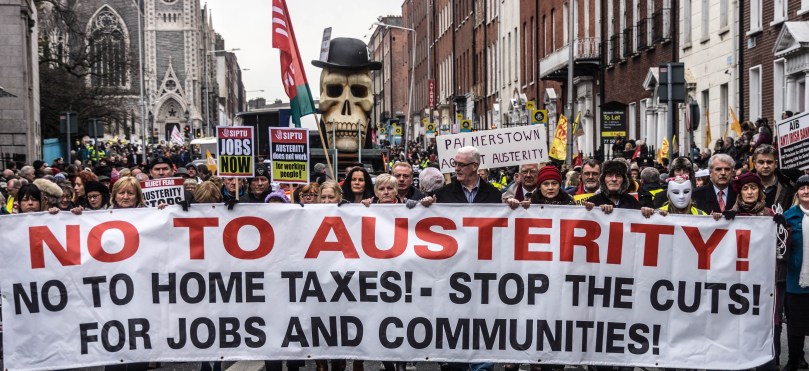
The increase in welfare provision is sorely needed in a catastrophic situation such as the one we face. But while the readiness to deploy instruments to achieve this is unprecedented, the measures themselves are not. Much of the welfare measures rolled out by governments are standard income support and welfare packages, larger in scale but with no fundamental changes in their basic design. Much of these measures, moreover, have been advocated by many to deal with fallouts from economic crises in the past, only to be met with middling levels of success and acceptance by the powers that be. The impact of the coronavirus has shown us how quickly governments can turn over the fundamental principles of austerity if they are pushed to do so. 

This post does not simply aim to criticise government policies of the past in light of current actions, but to outline a warning for the future. The problem of economic distress will not go away once the pandemic does, because then we will be dealing with battered economies, high unemployment, and weak to non-existent growth. In such times, when the threat of the virus has ebbed, there will be calls to roll back the welfare measures of the government. These calls will have to be countered stringently, on the grounds that the need to protect welfare and ensure government assistance is not contingent simply on the existence of a virus, but on the inability of the economic machine to provide for welfare.Read More »

COVID-19: A Bigger Challenge to the Indian Healthcare System

piqsels.com-id-fjlen

Covid-19 has reached the community spread phase. Developed or underdeveloped, rich or poor, all countries are affected by this today. However, they are facing these challenges – shortages in medical supplies and difficulty stopping its spread – in different magnitudes. In an attempt to stop the spread to save lives, Prime Minister Narendra Modi announced a 21-day lockdown, starting from 25th of March. Developing countries across the globe are looking down quickly, after witnessing the helplessness of the US, UK and the rest of Europe – though these are the countries with much stronger healthcare systems and much better availability of doctors. In Italy, doctors are forced to prioritize whom to save and whom to leave untreated.

India’s healthcare infrastructure is incapable of dealing with this crisis today. Shortages in medical supplies and an inability to provide adequate testing are the major issues. However, the Prime Minister’s announcement to allocate 15,000 crore rupees (USD 2 billion) for building infrastructure can strengthen the fight against coronavirus. Also, state governments are trying to expand facilities to deal with this situation.

The majority of Indians finance their healthcare themselves. About 62 percent of households’ expenditure on healthcare in 2017 was made through out-of-pocket payments. In comparison, the equivalent figures for the European Union (excluding UK) is 22.29 percent and for the USA and UK it is 11 percent and 16 percent, respectively (Table 1). While many patients diagnosed with Covid-19 will need Intensive Care Unit (ICU), there is no clarity from the government regarding who will pay these expenses. Read More »

The Specter of State Capitalism

17848 DOH Testing Lab

By Adam Dixon and Ilias Alami

Oh, how the righteous have fallen! As the global economy succumbs to COVID-19, we are haunted by the specter of state capitalism. Last week chief economic advisor to the White House, Larry Kudlow, suggested that the US government could take equity stakes in corporations in return for aid. Housing evictions are being postponed. Payroll for employees in some parts of the private sector are to be covered. And the list continues. In the UK, plans are afoot, dare one say, to renationalize the struggling airline sector and other companies.

At the moment, critics of such statist measures are too worried about their own personal health to make a fuss. But as we flatten the curve of the infected and the wheels of the market start turning again, the righteous apostles of the free market will return with a vengeance, and the state capitalists will tumble from their temporary thrones.

As with the last crisis just a decade ago, the state capitalists provided much needed support and took a humble bow (at a profit) when their services were no longer needed. Bailing out General Motors was a good deal for the US taxpayer, as was TARP. Certainly, the same will happen this time around. Or will it?

Since the election of Donald Trump in the US and the Brexit vote in the UK, the prophets of the free market have been decisively pushed out of the halls of power or forced to accept a different religion (typically that of an authoritarian and nationalist form of neoliberalism). National capital comes first!

Without a doubt, Trump and the Brexiteers did not foresee needing state ownership of industry and explicit state direction to achieve their goals. There are plenty of ways the state fosters, guides, and shapes private capital. Capitalism is never without the state, except in some libertarian utopia. State ownership just makes this relationship more explicit.

The embrace of Singapore as a post-Brexit economic model for the UK is telling in that respect. The government of Singapore continues to be a major shareholder of Singaporean industry and commerce, with no plans to change. Why should it? It owns successful and competitive companies. Indeed, state-owned enterprises the world over are demonstrating their competitive prowess. They aren’t the bureaucratic corporate sloths that we are told necessarily come with state ownership. Capital centralized in the hands of the state is resilient and growing for a reason. State-owned enterprises and state-controlled investment vehicles, such as sovereign wealth funds, are multiplying and growing the world over.

For the British elite, Brexit reflected an underlying lament of the sale of British industry (and finance) to foreign owners, even though many became rich that way. They know that restoring such past glory requires explicit action of the state, likely through more centralization of (national) capital. This is a reason behind the refusal to agree to level playing-field provisions with the EU in the future relationship negotiations. But there is more to this than returning to some past glory. Global capital accumulation is driven increasingly by capital centralized in the hands of the state.

The Trump administration’s battle with China (supported implicitly by other Western powers) is not driven by some desire to protect liberal rules-based international order. Rather, it is a battle of national capital. Afterall, China is capitalist.

China’s shift from assembling goods to also designing them, and doing so competitively, has unsettled the hierarchies of the world economy. But China is unwilling to relinquish its development model and its ownership of large swaths of Chinese industry. That is not in the DNA of the Chinese elite. Large state ownership is both necessary to secure the political dominance of the party state at home, and to expand and consolidate the integration of Chinese firms into global supply chains under favorable terms.

This is met in the US (and to a lesser extent other Western economies) by an increasingly aggressive form of techno-nationalism — a form of economic nationalism in the realms of trade, industrial, and investment policy, that aim at securing exclusive control of key scientific-technological innovations. National elites in the West more generally are realizing that they need state power to compete in the global economy. In reality, they always have. But the cloak of free-market neoliberalism energized their buccaneering self-confidence that they were above it all. That fiction is over.

The extension of state prerogatives by non-Western powers used to fuel all sorts of anxieties among state actors and observers in the West. Now, these very same modalities of state intervention are being called for, if not praised, by commentators across the political spectrum. Some even look with envy at the agility with which non-Western state capitalists are currently managing the crisis. The pace at which this ‘new normal’ is emerging is remarkable. We are all state capitalists now (or we all want to be).

COVID-19 and the generalized economic crisis it has catalyzed may hasten changes toward explicit forms of state capitalism in the West. Yet, a decloaked state at the helm does not necessarily mean a more progressive and just economic system (just like it does not mean a move toward state socialism). Who will bear the brunt of the costs of the current transformations, and who will benefit from the consolidation of the ‘new’ state capitalism, will be the outcome of a tense political process. This much we know.

Adam Dixon is Associate Professor of Globalization and Development at Maastricht University. Ilias Alami is a postdoctoral researcher at Maastricht University.

Photo by Governor Tom Wolf. Pennsylvania Commonwealth microbiologist Kerry Pollard performs a manual extraction of the coronavirus inside the extraction lab at the Pennsylvania Department of Health Bureau of Laboratories on Friday, March 6, 2020.
 

In Service of Neoliberalism – The Art and Science of Perpetuating the ‘State versus Market’ Dichotomy

71ts6MDJbbL

How should one assess a book on economic policy that takes a dim view of the state and redistribution in a country that is home to multiple and intersecting inequalities? Economic inequality and the role of the state in tackling inequality emerged as a major talking point in the last decade and it is likely that it will continue to animate academic and policy debates in the following decade too. Therefore, it would not be unreasonable to evaluate any book on economic policy based on the seriousness with which it engages with inequality and how it imagines state intervention in the economy. This review seeks to do precisely that by unpacking the conventional wisdom about the nature and role of the state presented in the book In Service of the Republic: The Art and Science of Economic Policy by Vijay Kelkar and Ajay Shah.Read More »

Indonesia’s State-Led Development: Custodian of the National Interest, or Boondoggle?

industry-4612432_1920Nobel Laureate Esther Duflo once likened the work of economists to that of plumbers – tinkering and adjusting as necessary as they engage with the details of economic policy-making. The implication in this comparison is that economists generally understand economic systems and behaviour how the pipes come together – and that the main work of the discipline is to fiddle with these components – adjusting the pressure, replacing valves – to see what works and what doesn’t.

A critique of this approach was compiled by Ingrid Harvold Kvangraven here. The primary criticism is that the basic premise is flawed – we do not, in fact, have a very complete understanding of how the pipes come together. Often, we don’t even know where they are. The institutional architecture that determines economic outcomes can vary widely from one country to the next. With so much variation at the systemic-level the utility of “tinkering” at the margins is questionable.

This blog series will interrogate some of the prevailing assumptions about the relationship between state and capital and look at why and in what ways some economies are deeply intertwined with the state. The structural conditions that actually exist in developing economies are often ignored in mainstream economic analyses – the prescription for countries with large state-owned sectors is usually some combination of more market liberalization, less protectionism, better enforcement of property rights. This ignores why the economy is structured that way in the first place, and therefore such prescriptions risk being disconnected from the reality on the ground, and thus ineffective.

Indonesia’s economic trajectory helps to illustrate this point. Despite a long history of sometimes violent anti-communist sentiment, massive portions of the economy are either partially or directly controlled by state-owned enterprises. According to Kyunghoon Kim in 2016 there were148 SOEs in Indonesia, and their total assets were equivalent to 56.9% of the country’s GDP.This includes the state-owned oil and gas company Pertamina, three of the four largest banks, the state-owned electric utility PLN which owns the entire national grid, airport operators Angkasa Pura I and II which operate every major commercial airport, the telecom giant PT Telekomunikasi Indonesia and the largest toll road operator Jasa Marga, to name just a few. Read More »

Lost in Technicalities: The Great Indian Slowdown

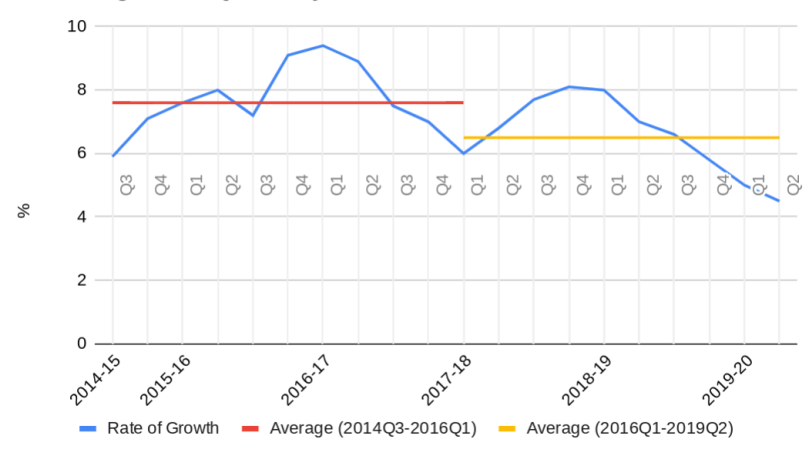
India’s Finance Minister Nirmala Sitharaman has said, while replying to a discussion on the economic slowdown in the Rajya Sabha, ‘growth may have come down, but it is not a recession yet and it won’t be a recession ever’. Drawing on data up until December 2019, I evaluate to what extent India’s economy is indeed slowing down.

Figure 1: Quarterly Rate of Growth of GDP in IndiaScreenshot 2020-01-21 at 09.42.32

No, it’s not a recession, defined strictly in technical terms, i.e. on the whole, the level of activity hasn’t fallen, even though certain crucial sectors, like automobiles, are seeing a fall. What we have instead is a slow down, a severe one at that, with falling rate of growth of GDP for five straight quarters (figure 1). The Indian government is hiding behind economic jargon to obfuscate the reality that is biting the economy. The writing is on the wall. The Indian economy is facing a severe crisis and the sooner we come to terms with it, the better. Based on a recent paper in Economic and Political Weekly, this blog discusses the changing growth levels in the Indian economy, the reasons for the recent slowdown, and some possible short and long term solutions.Read More »

Should the African lion learn from the Asian tigers? A comparison of FDI-oriented industrial policy in Ethiopia, South Korea and Taiwan

19095762104_2c72b2e569_o.jpg
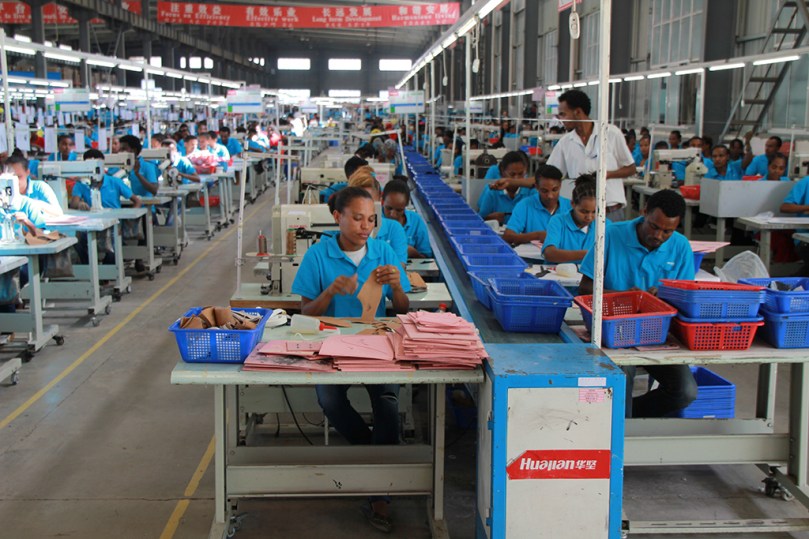
The Huajian shoe factory in the Eastern Industrial Zone in Ethiopia. Photo: UNIDO.

Ethiopia is being hailed as one of the most successful growth stories in Africa. Because of the country’s rapid economic growth, the high degree of state intervention in the economy, and the state’s focus on industrialization, people have started to compare Ethiopia to the Asian ‘tigers’ (Aglionby, 2017; Clapham, 2018; De Waal, 2013, Hauge and Chang, 2019; Oqubay, 2015) four countries in East Asia (Hong Kong, Singapore, South Korea and Taiwan) that underwent rapid industrialization and maintained exceptionally high growth rates in the post-WWII era.

However, this emerging literature on Ethiopia-Asia comparisons has not yet sufficiently addressed one of the most important aspects of Ethiopia’s industrialization strategy — the attraction of foreign direct investments (FDI) into the manufacturing sector.

The rationale of my recently published article was this gap in the literature. In it, I ask the question: Should the African lion learn from the Asian tigers with respect to FDI-oriented industrial policy? 

In short, my answer is yes. While Ethiopia’s policies are bringing about short-term economic success and showing promise for further industrialization, the state could arguably bargain harder with foreign investors, like it did in South Korea and Taiwan.Read More »

Islamic Finance and Financial Inclusion: Who Includes Whom, in What, and on Whose Terms?

Sabaibdjib

By Lena Rethel, University of Warwick.

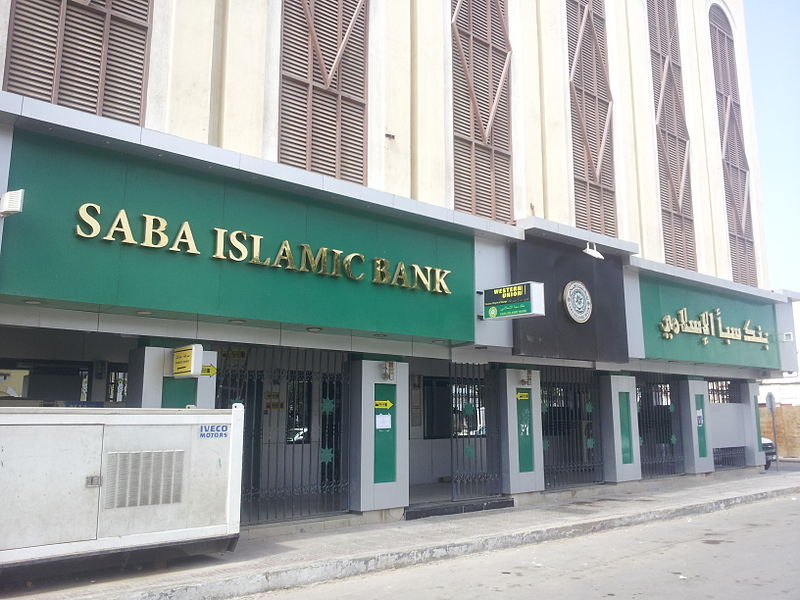
With the rise of financial inclusion as the new buzzword in global development circles, it has replaced earlier items on the reform agenda such as financial modernisation or financial deepening. By their very nature financial inclusion projects are inherently political – their underlying rationale is to change who has access to what forms of credit and at what conditions. Financial inclusion is both a multi-scalar and multi-faceted phenomenon. Needless to say that its dynamics play out differently in different countries and regions. However, before uncritically embracing the financial inclusion agenda as a means to achieving a more equitable economic order, more attention should be paid to what constitutes a fundamental set of questions: who includes whom, in what and on whose terms? In this blog entry, I want to highlight some of the key issues that have emerged in relation to Islamic finance. Read More »